
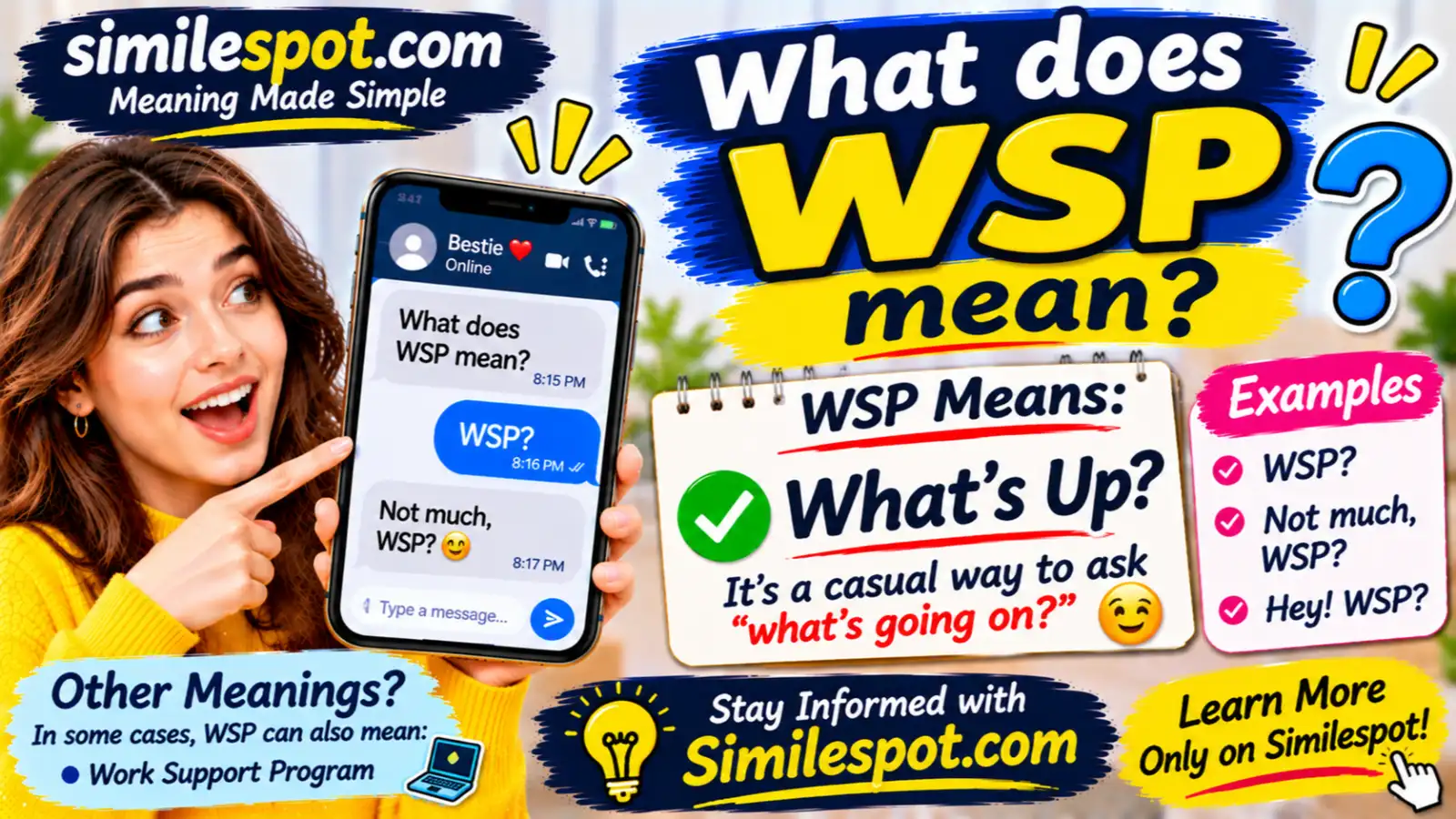
Have you ever received a message that simply says WSP and wondered what the sender was trying to say? Maybe a friend sent it on Snapchat, someone used it in an Instagram DM, or a new contact started a conversation with those three letters. If you are unsure how to respond, you are not alone.
So, what does WSP mean? In texting and online conversations, WSP usually stands for “What’s up?” It is a casual greeting people use to ask what someone is doing, how they are feeling, or whether anything interesting is happening.
Instead of typing the complete phrase, people shorten it to WSP to save time and keep conversations relaxed. It is especially common in informal messages between friends, classmates, and people who communicate regularly online.
For example:
Person A: WSP?
Person B: Not much, just watching a movie. You?
Simple, right? However, WSP can communicate slightly different things depending on the conversation, relationship, and platform. Sometimes it is just a friendly hello. Other times, it is an easy way to start a longer chat.
In this guide, you will learn what WSP means, where it comes from, how people use it, and how to reply naturally. You will also discover its possible meanings in different situations and see practical examples that make the abbreviation easy to understand. 😊
1. What Does WSP Mean in Texting?
The most common meaning of WSP in texting is “What’s up?” It is an informal greeting used to start a conversation or check in with someone.
When a person sends WSP, they might be asking:
- How are you?
- What are you doing?
- What’s happening?
- Is everything okay?
- Are you available to talk?
- Is there anything new?
The exact intention depends on the situation. For instance, a close friend might send WSP simply because they want to chat. Someone who has not spoken to you for a while might use it to reconnect.
A Simple Definition of WSP
WSP = What’s up?
It is a shortened expression that makes digital communication quicker and more casual.
Here are a few examples:
| Text Message | Meaning |
|---|---|
| WSP? | What’s up? |
| Hey, wsp | Hey, what’s up? |
| WSP bro? | What’s up, bro? |
| WSP with you? | What’s happening with you? |
| WSP today? | What’s happening today? |
Although WSP is short, it can open the door to almost any kind of conversation. You can use it to greet a friend, check on someone, or begin a casual discussion.
Is WSP a Greeting or a Question?
It can be both.
When someone sends WSP without additional words, they are usually greeting you while inviting a response. They may not expect a detailed explanation. A simple answer such as “Not much, you?” is often enough.
For example:
Alex: WSP?
Sam: Just relaxing. What’s up with you?
Here, both people use the phrase to keep the conversation moving.
2. What Does WSP Stand for and Where Did It Come From?
WSP commonly stands for “What’s up?” The expression itself existed long before modern texting became popular. People have used “What’s up?” as an informal greeting for many years.
The phrase does not always ask about a specific event. Instead, it often works like “Hello,” “How are you?” or “What are you doing?”
As mobile phones, instant messaging, and social media became part of everyday communication, people started shortening common expressions. This helped them type faster, especially when sending quick messages.
WSP developed as one of several compact greetings used in digital conversations.
Why Did People Start Using WSP?
There are several practical reasons:
- Faster communication: Typing three letters takes less time than writing a complete greeting.
- Casual conversations: WSP sounds relaxed and informal.
- Mobile-friendly messaging: Short messages are convenient when using a phone.
- Online culture: Social media encourages quick replies and abbreviated expressions.
- Easy recognition: Many people understand WSP without needing an explanation.
It is difficult to identify one person or exact moment when WSP first appeared. Like many internet abbreviations, it developed through informal online communication.
The important point is that WSP became a convenient way to write a familiar everyday expression.
3. How Is WSP Used in Everyday Conversations?
People use WSP in several situations. Although its basic meaning remains “What’s up?”, the intention can change depending on who sends it and what is happening.
Let’s explore its most common uses.
A. Starting a Conversation
One of the most common reasons to send WSP is to begin talking to someone.
For example:
Person A: WSP?
Person B: Hey! Nothing much. How about you?
The sender does not necessarily have an important question. They simply want to start a conversation.
B. Checking What Someone Is Doing
WSP can also ask about someone’s current activity.
For example:
Person A: WSP right now?
Person B: I’m finishing my homework.
In this situation, the sender wants to know what the other person is doing.
C. Checking on a Friend
Sometimes, WSP is a quick way to see how someone is feeling.
For example:
Person A: Hey, wsp? Haven’t talked to you today.
Person B: I’m good! Just had a busy morning.
This message combines a greeting with a friendly check-in.
D. Making Plans
Friends may use WSP when they want to arrange something.
For example:
Person A: WSP this weekend?
Person B: Nothing planned yet. Why?
Here, the sender may be checking whether the other person is available.
E. Reconnecting After a Long Time
WSP can also help restart a conversation that has been inactive.
For example:
Person A: Hey! WSP? It’s been a while.
Person B: Hey! I’m doing well. How have you been?
It is a simple, low-pressure way to reconnect.
4. What Does WSP Mean on Snapchat, Instagram, and Other Platforms?
The meaning of WSP generally stays the same across social media platforms. It usually means “What’s up?” However, the way people use it can vary slightly depending on the platform and conversation.
WSP on Snapchat 👻
On Snapchat, people often send short greetings through direct messages and snaps.
Someone might send:
- WSP?
- Wsp streaks?
- Hey, wsp?
- WSP tonight?
Usually, the person wants to start a conversation, check what you are doing, or maintain regular contact.
For example:
Friend: WSP?
You: Just chilling. What about you?
A WSP message does not automatically mean the sender wants something romantic. It may simply be a friendly greeting.
WSP on Instagram 📸
On Instagram, WSP commonly appears in direct messages.
Someone might use it after following your account, replying to a story, or starting a conversation.
Example:
New follower: Hey, wsp?
You: Nothing much. How’s your day going?
It can be a casual introduction, but you should consider the surrounding conversation before assuming the sender’s intentions.
WSP on WhatsApp 💬
On WhatsApp, WSP is often used between friends, relatives, and familiar contacts.
Example:
Cousin: WSP?
You: Just got home. What’s up?
Because WhatsApp conversations can be more personal, the abbreviation may also introduce a question or a request.
WSP on TikTok
TikTok users may use WSP in comments, private messages, and casual discussions.
Example:
User A: WSP?
User B: Just watching videos. 😂
The abbreviation still works as a quick greeting.
WSP on Gaming Platforms 🎮
Gamers may use WSP in chat when joining friends or checking whether someone is available.
Example:
Player A: WSP bro?
Player B: Getting ready for another match.
In this context, the message may be an invitation to talk or play together.
Quick Platform Comparison
| Platform | Common Use of WSP |
|---|---|
| Snapchat | Starting a casual chat |
| Sending a direct-message greeting | |
| Checking in with someone | |
| TikTok | Starting a conversation |
| Gaming chats | Greeting friends or checking availability |
| Text messages | Asking what’s happening |
Remember: The platform does not usually change the basic meaning. Context helps you understand the sender’s actual intention.
5. Real-Life WSP Texting Examples and Conversations
The easiest way to understand WSP is to see how people use it in everyday messages.
Below are realistic examples showing different situations.
Example 1: Talking to a Friend
Person A: WSP?
Person B: Not much, just relaxing. You?
Meaning: Person A is asking what Person B is doing.
Example 2: Checking on Someone
Person A: Hey, wsp?
Person B: I’m good. Just got back from school.
Meaning: The sender is greeting the other person and checking in.
Example 3: Making Weekend Plans
Person A: WSP this Saturday?
Person B: Nothing yet. Are you planning something?
Meaning: The sender wants to know whether the other person is available.
Example 4: Starting a New Conversation
Person A: Hey, wsp?
Person B: Hi! Not much. What’s up with you?
Meaning: The sender is opening a casual conversation.
Example 5: Talking to a Gaming Friend
Person A: WSP bro?
Person B: Waiting for the squad. Want to join?
Meaning: The sender is checking in with a friend.
Example 6: Reconnecting With Someone
Person A: WSP? Haven’t heard from you in ages.
Person B: I know! I’ve been busy lately. How are you?
Meaning: The sender wants to restart communication.
Example 7: Asking About a Situation
Person A: WSP with the project?
Person B: Almost finished. I just need to check the last section.
Meaning: Here, WSP asks what is happening with a particular project.
Example 8: A Quick Morning Greeting
Person A: Morning! WSP?
Person B: Just getting ready for the day.
Meaning: The sender is greeting someone and asking about their plans.
Example 9: Checking Availability
Person A: WSP later?
Person B: I’m free after 6.
Meaning: The sender may be asking whether the other person is available later.
Example 10: Casual Group Chat
Person A: WSP everyone?
😀Person B: Nothing much here.
Person C: Just watching a movie.
Meaning: The sender is greeting the entire group and inviting people to respond.
These examples show that WSP is flexible. It can introduce a friendly chat, ask about current activities, or help people make plans.
6. How to Reply When Someone Sends You WSP
If someone texts you WSP, you do not need to write a complicated response. A short, natural answer usually works perfectly.
Your reply should depend on your relationship with the sender and whether you want to continue the conversation.
Here are some useful responses.
Casual Replies
Use these when replying to friends or people you know well:
- Not much, you?
- Just chilling.
- Nothing special.
- All good here!
- Just relaxing.
- Same old, same old.
- Just watching a movie.
Friendly Replies
If you want to sound warm and welcoming, try these:
- Hey! I’m doing great. How about you?
- Not much. How’s your day going?
- Just finished my work. What’s up?
- Everything’s good. What about you?
- Hey! Nice to hear from you.
Funny Replies 😂
A little humor can make a casual conversation more interesting:
- Just fighting boredom!
- Waiting for something exciting to happen.
- Trying to become productive. 😂
- Searching for snacks.
- Surviving another busy day!
Replies When You Are Busy
You can respond politely without starting a long conversation:
- A little busy right now. What’s up?
- Just finishing something.
- I’ll message you later.
- Working on something important.
- Can we talk in a bit?
Replies When You Want to Make Plans
If you think the sender wants to meet or do something, you can say:
- Nothing planned yet. Why?
- I’m free later. What’s the plan?
- Just relaxing. Want to hang out?
- I might be available this evening.
- What are you thinking?
Reply Examples by Situation
| Situation | Suggested Reply |
|---|---|
| A close friend texts WSP | Not much, you? |
| Someone checks on you | I’m good! How are you? |
| You are busy | A little busy. What’s up? |
| You want to make plans | Nothing planned. Why? |
| You want a funny reply | Just avoiding responsibilities! |
| You want to end the chat | All good here. Talk later! |
Helpful tip: You do not have to match the sender’s abbreviation. A complete sentence is perfectly fine, too.
7. Is WSP Flirty, Friendly, Rude, or Romantic?
A common question about texting abbreviations is whether they reveal someone’s feelings.
WSP is generally neutral and casual. By itself, it does not prove that someone is flirting, being rude, or expressing romantic interest.
The tone depends on the surrounding messages, the sender’s communication style, and your relationship.
Is WSP Flirty?
It can be part of a flirty conversation, but it is not automatically flirty.
For example:
Person A: Hey, wsp? 😊
Person B: Not much. What about you?
The emoji and previous conversation may make the greeting feel warmer. However, the abbreviation alone does not communicate romantic interest.
Is WSP Friendly?
Yes. This is its most common use.
Friends often send WSP because it is a quick and comfortable way to start chatting.
Example:
Friend: WSP bro?
You: Just chilling. What’s good?
Is WSP Rude?
Usually, no.
WSP is a normal informal greeting. However, any short message can feel abrupt if the sender uses it without considering the situation.
For example, sending only WSP during a serious conversation may feel too casual. That does not mean the abbreviation itself is offensive.
Does WSP Mean Someone Misses You?
Not necessarily.
Someone may send WSP because they want to reconnect, but it does not automatically mean they miss you. Look at the rest of the conversation to understand their intention.
Understanding the Tone
| Message | Possible Tone |
|---|---|
| WSP bro? | Friendly |
| Heyyy, wsp? | Warm and casual |
| WSP? 😊 | Friendly or playful |
| WSP tonight? | Checking availability |
| WSP with the assignment? | Asking for an update |
| WSP after all this time? | Reconnecting |
The best approach is to avoid making assumptions from three letters. Consider the full message and the sender’s usual communication style.
8. WSP vs. Other Popular Texting Abbreviations
WSP is not the only shortened greeting used in digital conversations. People use many other abbreviations to communicate quickly.
Although some expressions have similar meanings, they are not always interchangeable.
Let’s compare WSP with other common texting terms.
| Abbreviation | Full Form | Common Meaning |
|---|---|---|
| WSP | What’s up? | Asking what is happening |
| SUP | What’s up? | Casual greeting |
| WYD | What You Doing? | Asking about someone’s activity |
| HRU | How Are You? | Checking on someone’s well-being |
| HY | Hey | Starting a conversation |
| WYA | Where You At? | Asking about someone’s location |
| HBU | How About You? | Returning a question |
| NM | Not Much | Saying nothing special is happening |
| NVM | Never Mind | Taking back or dismissing a request |
| BRB | Be Right Back | Temporarily leaving a conversation |
WSP vs. SUP
Both WSP and SUP are commonly used as casual greetings.
- WSP: Short for “What’s up?”
- SUP: A shortened spelling of “What’s up?”
Example:
Friend A: WSP?
Friend B: Sup! Just relaxing.
Their meanings are very similar.
WSP vs. WYD
These expressions are related but slightly different.
- WSP asks what is happening or how things are going.
- WYD specifically asks what someone is doing.
Example:
WSP?
Not much. Just relaxing.
WYD?
I’m watching a movie.
WSP vs. HRU
HRU means “How are you?” It focuses more directly on someone’s well-being.
WSP is broader. It can ask about someone’s activities, plans, or general situation.
WSP vs. WYA
WYA means “Where You At?” It usually asks about someone’s location.
WSP does not normally ask for a physical location. It is a general greeting.
Knowing these differences can help you understand messages more accurately and choose the right abbreviation when chatting.
9. Common Mistakes People Make When Understanding WSP
Although WSP is easy to understand, people sometimes misunderstand it because they interpret every abbreviation without considering context.
Here are some common mistakes to avoid.
Mistake 1: Assuming WSP Has Only One Possible Interpretation
“What’s up?” is the standard texting meaning, but the surrounding words can change the question.
For example:
WSP with the order?
This asks for an update about an order rather than simply greeting someone.
Mistake 2: Thinking Every WSP Message Is Flirty
A person sending WSP may simply want to talk. It does not automatically mean they have romantic feelings.
Mistake 3: Confusing WSP With WYD
Both expressions can start conversations, but WYD focuses on what someone is doing.
WSP is more general.
Mistake 4: Using WSP in Every Situation
WSP is informal. It may not be suitable for professional emails, formal requests, or serious conversations.
Instead, use a complete greeting when the situation requires politeness.
Mistake 5: Ignoring the Conversation Around It
A single abbreviation rarely tells the whole story.
Compare these messages:
- WSP bro?
- WSP with your application?
- WSP this weekend?
Each one has a slightly different purpose.
Mistake 6: Assuming the Sender Expects a Long Reply
Most people who send WSP are comfortable with a short response.
You can simply say, “Not much, you?” and continue naturally.
The key lesson: Understand the sentence before deciding what an abbreviation means. Context is often more important than the letters themselves.
10. When Should You Use WSP and When Should You Avoid It?
WSP is useful when you want to communicate quickly and casually. However, not every conversation has the same tone or level of formality.
Knowing when to use it helps you avoid awkward communication.
When WSP Is Appropriate
You can comfortably use WSP in situations such as:
- Messaging close friends.
- Starting a casual conversation.
- Checking what someone is doing.
- Talking in a group chat.
- Sending informal social media messages.
- Reconnecting with familiar people.
- Chatting with gaming friends.
For example:
You: Hey, WSP?
Friend: Nothing much. What’s up?
This is a natural and simple exchange.
When You Should Avoid WSP
Consider using a complete greeting instead in these situations:
- Writing a formal email.
- Contacting a teacher about an important matter.
- Messaging a manager or employer.
- Communicating with someone you do not know well in a professional setting.
- Discussing a serious or sensitive issue.
- Making an official request.
For example, instead of writing:
WSP, can you help me with the assignment?
You could write:
Hello, I hope you are doing well. Could you please help me with the assignment?
The second message sounds more appropriate in a formal situation.
Formal and Informal Alternatives
| Situation | Better Expression |
|---|---|
| Close friend | WSP? |
| Classmate | Hey, what’s up? |
| Teacher | Hello, how are you? |
| Manager | Good morning. I hope you’re well. |
| New professional contact | Hello, nice to connect with you. |
| Family member | Hey, how’s everything? |
The goal is not to avoid abbreviations completely. It is to choose language that fits the person and situation.
11. Other Possible Meanings of WSP in Different Contexts
Although “What’s up?” is the most common meaning of WSP in casual texting, abbreviations can have different meanings in specialized environments.
For example, a business, technical team, gaming community, or online group may use the same letters for something specific.
This is why context matters.
WSP in General Online Communication
In everyday chats, WSP usually means “What’s up?” This is the interpretation you should consider first when someone sends it as a standalone greeting.
WSP in Professional or Technical Conversations
In a workplace or technical discussion, WSP may be an organization-specific or industry-specific abbreviation.
For example, a team might define its own shorthand in internal messages. The meaning would depend on that team’s terminology.
You should not automatically interpret every professional use as “What’s up?”
WSP in a Sentence
Consider these examples:
Example A:
“Hey, WSP?”
This is almost certainly a casual greeting.
Example B:
“WSP with the meeting schedule?”
Here, the sender wants an update about the schedule.
Example C:
“Our team uses WSP for a project label.”
In this case, the letters may represent an internal term rather than a greeting.
How Can You Identify the Correct Meaning?
Use these simple steps:
- Check the sentence: Look at the words surrounding WSP.
- Identify the platform: A casual DM is more likely to use the texting meaning.
- Consider the sender: A friend may be greeting you, while a colleague may be discussing work.
- Read previous messages: Earlier conversation can clarify the intention.
- Ask politely: If the abbreviation is unclear, ask what the sender means.
For example:
You: Just checking, do you mean “what’s up?”
There is nothing wrong with asking for clarification. It is better than making an incorrect assumption.
FAQs:
Here are answers to some common questions people ask about this abbreviation.
1. What does WSP mean in a text message?
WSP usually means “What’s up?” It is a casual greeting used to ask what someone is doing, how things are going, or whether anything interesting is happening.
2. What does WSP mean on Snapchat?
On Snapchat, WSP generally means “What’s up?” People use it in messages and snaps to start conversations, greet friends, or check what someone is doing.
3. How should I reply when someone says WSP?
You can reply with something simple, such as “Not much, you?”, “Just chilling,” or “I’m doing great! How about you?” Choose a response that matches your relationship with the sender.
4. Is WSP the same as WYD?
No. WSP means “What’s up?” and works as a general greeting or question about what is happening. WYD means “What You Doing?” and focuses more specifically on someone’s current activity.
5. Is WSP rude or flirty?
WSP is usually a neutral, informal greeting. It is not automatically rude or flirty. The sender’s tone, relationship with you, and surrounding messages help determine the intention.
Final Thoughts:
So, what does WSP mean? In most casual text messages and online conversations, WSP stands for “What’s up?” It is a short, friendly expression people use to greet others, check in, ask about current activities, or start a conversation.
You may see WSP on Snapchat, Instagram, WhatsApp, TikTok, gaming chats, and regular text messages. Its basic meaning generally stays the same across these platforms.
Remember these important points:
- WSP means “What’s up?” in everyday texting.
- It is commonly used as an informal greeting.
- People use it to start conversations and check in with others.
- A simple reply such as “Not much, you?” works in most situations.
- WSP is generally neutral, not automatically rude or flirty.
- Context helps you understand its exact purpose.
- It is better suited to casual conversations than formal communication.
Once you understand WSP, you can recognize it easily and respond without confusion. 😊
Want to understand more texting abbreviations? Explore related posts about WYD, WYA, SUP, HRU, and other popular internet slang terms on SimileSpot to make everyday online conversations easier to follow.

I am a passionate writer at SimileSpot who loves playing with words. I create clear and creative similes to make ideas easy to understand and fun to read.