Have you ever received a message saying, “That’s cap!” and wondered what the other person was talking about? Perhaps you saw someone comment “No cap” under a TikTok video or heard a friend use the expression during a conversation. If you are unfamiliar with modern internet slang, this phrase can sound confusing at first.
So, what does cap mean in slang?
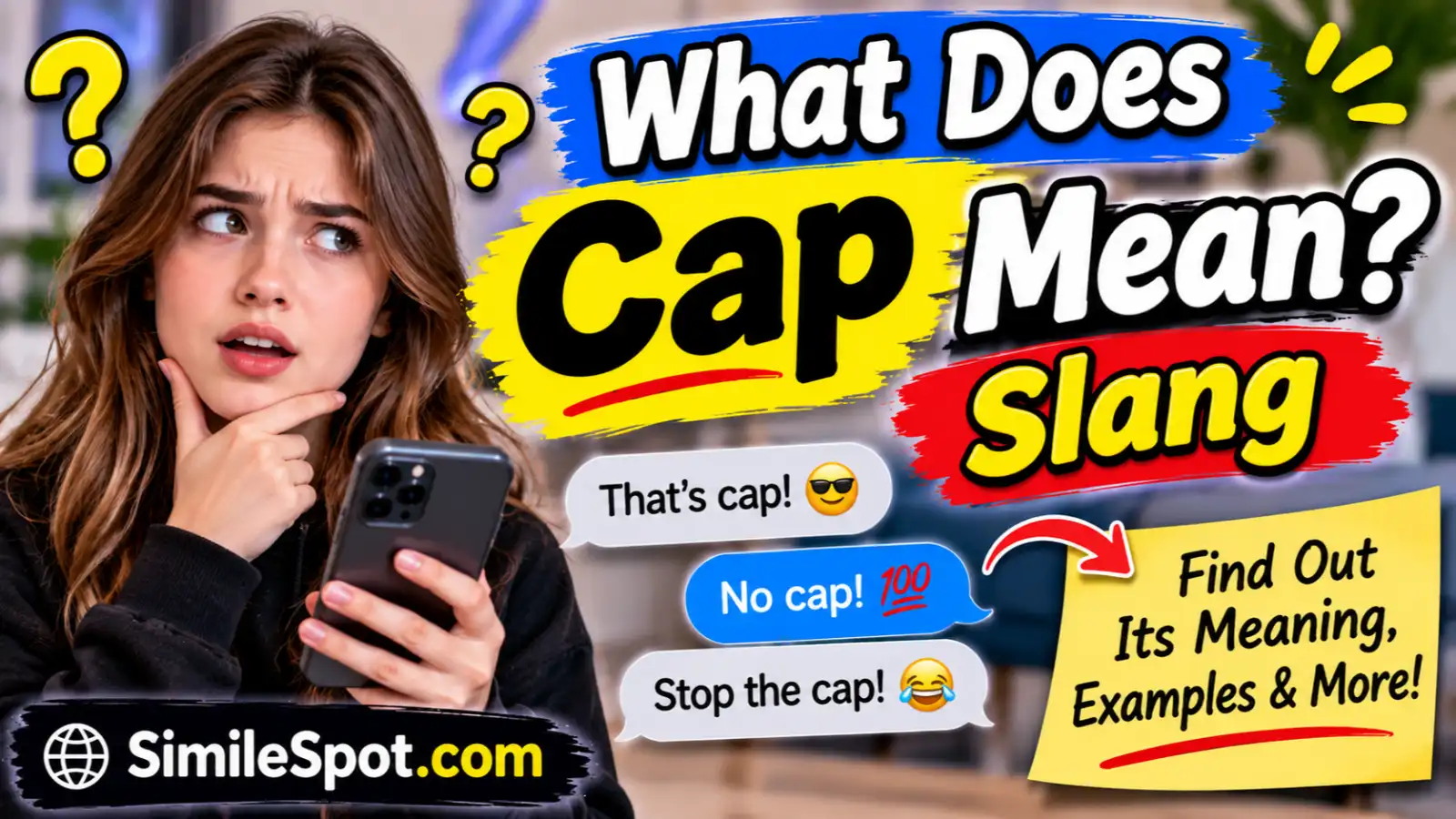
In modern slang, cap means a lie, something untrue, or an exaggerated statement. When someone says “That’s cap,” they are suggesting that another person is not telling the truth. On the other hand, “No cap” means “I’m telling the truth” or “I’m being completely serious.”
For example:
- “I won £500 yesterday.”
- “That’s cap!”
Here, the second person thinks the first person’s statement is probably false.
Another example:
- “This is the best movie I’ve ever watched, no cap!”
In this sentence, the speaker is emphasizing that their opinion is genuine.
The expression has become popular in text messages, online comments, memes, and social media conversations. You might encounter it on TikTok, Instagram, Snapchat, YouTube, or even in everyday conversations with friends.
In this complete guide, we will explain what cap means in slang, where it originated, how people use it, and what different variations mean. You will also discover practical examples, common mistakes, and natural ways to respond.
Let’s explore this popular expression! 🚀
1. What Does Cap Mean in Slang? 🤔
The slang word cap means a lie or an untrue statement. People use it when they believe someone is exaggerating, making something up, or not being honest.
It is an informal expression that has become common in modern internet culture.
For example:
Person A: “I can finish this entire project in five minutes.”
Person B: “That’s cap!”
Person B is suggesting that the statement is unrealistic or untrue.
The word can also describe exaggerated stories, unbelievable claims, or statements that someone does not trust.
Simple Definition of Cap
| Term | Meaning |
|---|---|
| Cap | A lie or false statement |
| No cap | No lie; telling the truth |
| Stop the cap | Stop lying or exaggerating |
| Capping | Lying or making things up |
| That’s cap | That’s not true |
| No capping | Being honest or serious |
Why Do People Say Cap?
There are several reasons people use this expression.
- Quick communication: It takes less time to type than “You’re lying.”
- Casual language: It fits naturally into friendly conversations.
- Humorous reactions: It can make a disagreement sound playful.
- Social media culture: It is widely recognized in online conversations.
- Emphasis: It helps people express disbelief or sincerity.
For example, imagine your friend tells you they completed ten assignments in one hour.
You might reply:
“Ten assignments in one hour? That’s cap!”
Your response communicates that you find the statement hard to believe.
However, remember that cap is informal slang. It is best suited to casual conversations rather than professional writing.
2. What Does No Cap Mean? 💯
One of the most popular variations of cap is no cap.
No cap means “no lie,” “for real,” or “I’m telling the truth.”
People use it when they want to emphasize that their statement is genuine. It can also show that they are serious about an opinion or feeling.
For example:
“This is the best pizza I’ve ever tasted, no cap!”
The speaker is saying that they genuinely believe the pizza is excellent.
Examples of No Cap in Everyday Conversations
Here are some natural examples:
- “You have the best music taste, no cap.”
- “That was an amazing performance, no cap.”
- “I’m really tired today, no cap.”
- “This game is difficult, no cap.”
- “You are one of my best friends, no cap.”
- “That restaurant serves incredible food, no cap.”
- “I genuinely enjoyed the movie, no cap.”
- “This is the funniest video I’ve seen all week, no cap.”
No Cap vs. Cap
These two expressions have opposite meanings.
| Expression | Meaning | Example |
|---|---|---|
| Cap | A lie or false statement | “You’re making that up. That’s cap!” |
| No cap | The truth or honesty | “I really enjoyed it, no cap.” |
Easy trick to remember:
- Cap = Not telling the truth.
- No cap = Telling the truth.
This simple difference makes the expressions easy to understand.
3. What Does Stop the Cap Mean? 🛑
Another popular variation is stop the cap.
It means “stop lying,” “stop exaggerating,” or “be honest.”
People usually say it when they believe someone is making unrealistic claims or telling an unbelievable story.
For example:
Person A: “I can beat every professional football player.”
Person B: “Bro, stop the cap!”
Person B is telling the other person to stop making exaggerated claims.
More Examples of Stop the Cap
- “You didn’t really finish that game in two minutes. Stop the cap!”
- “Stop the cap, we both know what happened.”
- “You said you were sleeping, but you were online. Stop the cap!”
- “He claims he knows every song ever made. Stop the cap!”
- “Stop the cap! That story sounds impossible.”
When Should You Use This Expression?
You can use stop the cap in situations such as:
- When a friend exaggerates a story.
- When someone makes an unbelievable claim.
- When you think a person is joking about something serious.
- When someone gives an explanation that sounds suspicious.
- When you want to challenge a statement playfully.
However, be careful with your tone. Although the phrase is often humorous, it can sound confrontational if used during a serious disagreement.
4. Origin and History of Cap Slang 🕰️
Understanding the history of internet slang can make modern expressions even more interesting.
The slang use of cap has roots in African American Vernacular English (AAVE) and Black cultural language. It became more widely recognized through music, particularly hip-hop, and later spread across internet culture.
The expression did not suddenly appear with TikTok. Its history goes back much further.
Where Did the Word Cap Come From?
The exact development of cap as a slang term is not tied to one confirmed inventor.
However, the word has been used in expressions involving boasting, exaggeration, and dishonesty in Black American speech and cultural contexts.
The phrase “no cap” also became especially recognizable through hip-hop music.
How Did Cap Become Popular Online?
Several developments helped spread the expression.
1. Hip-Hop and Music Culture
Music helped introduce cap and no cap to wider audiences. Artists used the expression in songs and lyrics, making it familiar to listeners.
2. Social Media Growth
As online platforms expanded, users began including cap in comments, posts, and everyday digital conversations.
3. Memes and Viral Videos
Funny videos and memes helped make phrases such as “That’s cap” and “Stop the cap” widely recognizable.
4. TikTok Popularity
TikTok creators frequently use short slang expressions. Cap became a convenient way to react to unbelievable statements and exaggerated stories.
5. Everyday Conversations
Eventually, the expression moved beyond music and online entertainment. Many people began using it in regular conversations with friends.
Is Cap an Official English Word?
Cap is an established English word with several meanings. For example, it can refer to a type of hat or a cover placed over something.
However, its slang meaning is informal.
When people use cap to mean a lie, they are using a casual expression rather than formal vocabulary.
5. What Does Cap Mean in Texting and Chatting? 📱
In texting, cap usually means someone is lying, exaggerating, or making an untrue statement.
It is especially useful when someone wants to react quickly to a message.
Instead of writing:
“I don’t believe what you just said.”
A person can simply reply:
“Cap!”
This shorter response communicates disbelief.
Common Texting Situations
1. Reacting to an Unbelievable Story
Friend: “I met three famous actors yesterday.”
You: “Cap!”
Meaning: You do not believe the story.
2. Responding to an Exaggerated Claim
Friend: “I’m the fastest runner in the entire school.”
You: “That’s cap!”
Meaning: You think the claim is exaggerated.
3. Expressing Honesty
Friend: “Do you really like this song?”
You: “Yes, no cap.”
Meaning: You genuinely like the song.
4. Challenging Someone’s Explanation
Friend: “I didn’t see your message.”
You: “Stop the cap!”
Meaning: You suspect that the explanation is not true.
Cap in Different Messaging Platforms
| Platform | Common Usage | Example |
|---|---|---|
| Casual replies | “That’s cap!” | |
| Comments and DMs | “No cap, amazing photo.” | |
| Snapchat | Quick conversations | “Bro, stop the cap.” |
| TikTok | Video comments | “This is cap.” |
| YouTube | Comment sections | “No cap, this is hilarious.” |
| Discord | Gaming conversations | “You’re capping!” |
The meaning generally stays the same across these platforms.
6. 30 Real-Life Examples of Cap and No Cap 💬
The easiest way to understand slang is to see it used in realistic situations.
Here are 30 examples showing how cap, no cap, and related expressions work in everyday conversations.
Examples of Cap
- “You said you finished the entire book in ten minutes. That’s cap!”
- “I don’t believe that story. Cap!”
- “He claims he can run faster than a professional athlete. That’s cap.”
- “You didn’t really forget your homework again. Stop the cap!”
- “She said she never uses social media. That’s cap.”
- “Bro, you’re making that up. Total cap.”
- “I doubt he knows how to play every instrument. That’s cap.”
- “You can’t seriously believe that. Stop the cap!”
- “That sounds like a made-up story.”
- “He says he never makes mistakes. That’s cap!”
Examples of No Cap
- “This is my favorite restaurant, no cap.”
- “You did a fantastic job, no cap.”
- “I’m really excited about the trip, no cap.”
- “That was the funniest joke I’ve heard today, no cap.”
- “I genuinely appreciate your help, no cap.”
- “This game is harder than I expected, no cap.”
- “You have great ideas, no cap.”
- “I’m telling you the truth, no cap.”
- “That performance was incredible, no cap.”
- “I really enjoyed spending time with everyone, no cap.”
Examples of Capping
- “Why are you capping about your test results?”
- “He’s capping about knowing that celebrity.”
- “Stop capping and tell me what happened.”
- “I think you’re capping right now.”
- “She was capping about finishing the project.”
Examples of Stop the Cap
- “You bought ten cars yesterday? Stop the cap!”
- “Stop the cap, nobody believes that story.”
- “He says he never gets tired. Stop the cap!”
- “Bro, stop the cap and be honest.”
- “You didn’t really eat all that food. Stop the cap!”
Quick Example Table
| Sentence | Meaning |
|---|---|
| “That’s cap!” | That’s a lie. |
| “No cap!” | I’m telling the truth. |
| “Stop the cap!” | Stop lying. |
| “You’re capping.” | You’re lying or exaggerating. |
| “No capping.” | No lying; being honest. |
7. What Does Capping Mean in Slang? 🗣️
The word capping is another variation of cap.
Capping means lying, exaggerating, or making claims that are not true.
It is the continuous form of the slang verb “cap.”
For example:
“He’s capping about his new car.”
This means the person is believed to be lying or exaggerating about owning a new car.
Common Examples of Capping
- “Why are you capping?”
- “Stop capping about your achievements.”
- “She’s capping about what happened yesterday.”
- “I know you’re capping right now.”
- “He keeps capping in every conversation.”
Cap vs. Capping
Although the expressions are related, they are used differently.
| Word | Meaning | Example |
|---|---|---|
| Cap | A lie | “That’s cap.” |
| Capping | Lying or exaggerating | “You’re capping.” |
| No cap | Telling the truth | “No cap, I enjoyed it.” |
| Stop the cap | Stop lying | “Stop the cap, bro.” |
Think of capping as an action and cap as the statement or idea being described.
8. What Does Cap Mean on TikTok, Instagram, and Snapchat? 📲
Social media has played a major role in spreading modern slang.
Cap is particularly useful online because it is short, expressive, and easy to understand once you know its meaning.
However, people sometimes use it differently depending on the platform.
Cap Meaning on TikTok
On TikTok, cap often appears in comments and video reactions.
People use it when they think a creator is exaggerating, making an unbelievable claim, or presenting something misleading.
Examples:
- “That’s cap!”
- “No cap, this video is amazing.”
- “Bro is definitely capping.”
- “Stop the cap!”
It is also used jokingly between friends.
Cap Meaning on Instagram
Instagram users commonly include cap in comments, direct messages, and captions.
Examples:
- “No cap, your photography is incredible.”
- “That’s cap, I saw what happened.”
- “This outfit is amazing, no cap.”
It can be used to compliment someone or challenge an unbelievable statement.
Cap Meaning on Snapchat
Snapchat conversations are usually quick and informal.
Examples:
- “Cap 😂”
- “No cap, that was funny.”
- “You’re capping.”
- “Stop the cap!”
The abbreviation works particularly well when responding to a friend’s message or story.
Cap Meaning in Gaming Communities
Gamers also use cap in online conversations.
For example:
Player A: “I won ten matches in a row.”
Player B: “No way, that’s cap!”
Player B is questioning whether the achievement is genuine.
The expression can also appear in gaming livestreams, community chats, and video comments.
9. How to Reply When Someone Says Cap? 💡
Now that you understand what cap means, you may wonder how to respond when someone uses it in a conversation.
Your reply depends on whether the person is joking, questioning your honesty, or expressing disbelief.
Here are some natural responses.
When Someone Says “That’s Cap!”
You can respond with:
- “I’m serious!”
- “No, I’m telling the truth.”
- “Believe me, it’s real.”
- “No cap, I promise.”
- “I wouldn’t make that up.”
These responses work when someone doubts something you said.
When Someone Says “No Cap!”
You can reply:
- “I believe you!”
- “For real?”
- “That’s great!”
- “Same here!”
- “I agree!”
When Someone Says “Stop the Cap!”
Possible responses include:
- “I’m being honest.”
- “I’m not making anything up.”
- “You have to believe me.”
- “Seriously, it’s true.”
- “I promise I’m telling the truth.”
When Someone Says “You’re Capping”
You might respond:
- “No, I’m not!”
- “Why would I make that up?”
- “I’m completely serious.”
- “That’s exactly what happened.”
- “I can prove it.”
A Complete Conversation Example
Alex: “I finished the entire assignment last night.”
Sam: “That’s cap!”
Alex: “No cap, I actually finished it.”
Sam: “Okay, I believe you now!”
This conversation demonstrates how the expressions work naturally.
10. Cap vs. Other Popular Internet Slang Words 🔤
Cap is only one of many expressions used in modern digital conversations.
Understanding similar slang words can help you recognize the meaning of online messages more easily.
Here are some popular expressions worth learning.
1. Cap vs. No Cap
- Cap means a lie or false statement.
- No cap means honesty or truth.
Example:
“That’s cap!” versus “No cap, I’m serious.”
2. Cap vs. FR
FR stands for “For Real.”
People use it to express agreement, surprise, or sincerity.
Example:
“That movie was amazing, FR!”
3. Cap vs. NGL
NGL stands for “Not Gonna Lie.”
It introduces an honest opinion or confession.
Example:
“NGL, I really enjoyed that movie.”
4. Cap vs. TBH
TBH stands for “To Be Honest.”
It is used when someone wants to express a genuine opinion.
Example:
“TBH, I think this is a great idea.”
5. Cap vs. IDK
IDK means “I Don’t Know.”
It expresses uncertainty rather than dishonesty.
Example:
“IDK what happened yesterday.”
6. Cap vs. Sus
Sus is short for “Suspicious.”
It describes something that seems questionable or unusual.
Example:
“That explanation sounds sus.”
Comparison Table
| Slang | Full Form or Meaning | Usage |
|---|---|---|
| Cap | Lie or false statement | Calling out dishonesty |
| No Cap | No lie | Expressing honesty |
| FR | For Real | Agreement or sincerity |
| NGL | Not Gonna Lie | Sharing an honest opinion |
| TBH | To Be Honest | Expressing an opinion |
| IDK | I Don’t Know | Showing uncertainty |
| Sus | Suspicious | Questioning something |
| Bet | Okay or agreed | Accepting a suggestion |
| Lowkey | Slightly or secretly | Expressing something subtly |
| Highkey | Strongly or openly | Emphasizing a feeling |
These expressions may appear together in social media conversations, but each one has its own meaning.
11. Common Mistakes People Make When Using Cap ⚠️
Although cap is easy to understand, people sometimes misunderstand the expression or use it in the wrong situation.
Here are some common mistakes to avoid.
Mistake 1: Thinking Cap Always Means a Hat
In standard English, a cap can refer to a type of headwear.
However, in internet slang, it usually means a lie or false statement.
For example:
“That’s cap!”
This does not mean someone is talking about a hat. It means they believe something is untrue.
Mistake 2: Confusing Cap With No Cap
These expressions have opposite meanings.
- Cap = A lie.
- No cap = No lie.
Remembering this difference prevents confusion.
Mistake 3: Using Cap in Formal Emails
Cap is casual slang and does not usually belong in professional communication.
Instead of writing:
“That’s cap!”
You could write:
“That statement appears to be inaccurate.”
This version sounds more appropriate in formal situations.
Mistake 4: Assuming Every Use Is Serious
Friends often use cap jokingly.
For example:
“You ate the entire pizza? That’s cap!”
The person might simply be teasing their friend.
Therefore, consider the tone of the conversation before assuming someone is making a serious accusation.
Mistake 5: Using It Without Understanding the Context
Not everyone understands internet slang.
If you use cap with someone unfamiliar with the expression, your message might confuse them.
When clarity matters, simply say “That’s not true” or “I’m being honest.”
Mistake 6: Treating Every Unbelievable Statement as a Lie
Sometimes people genuinely share surprising experiences.
Calling everything cap can make conversations unpleasant.
It is better to understand the situation before questioning someone’s honesty.
12. Frequently Asked Questions About Cap Slang ❓
1. What Does Cap Mean in Slang?
Cap means a lie, false statement, or exaggeration in modern slang. When someone says “That’s cap,” they mean they do not believe what another person is saying. For example, “You finished that entire project in five minutes? That’s cap!”
2. What Does No Cap Mean in Texting?
No cap means “no lie,” “for real,” or “I’m telling the truth.” People use it to emphasize that their statement is genuine. For example, “This is the best song I’ve heard all year, no cap!”
3. What Does Stop the Cap Mean?
Stop the cap means “stop lying” or “stop exaggerating.” It is commonly used when someone believes another person is making an unbelievable claim or telling an untrue story.
4. What Does Capping Mean in Slang?
Capping means lying, exaggerating, or making something up. For example, “He’s capping about his achievements” suggests that the person is not being completely honest about what they have accomplished.
5. Where Did Cap Slang Originate?
Cap has roots in African American Vernacular English (AAVE) and Black American cultural language. It became more widely recognized through hip-hop and later spread through social media, memes, and everyday online conversations.
Conclusion:
Now you know exactly what cap means in slang and why people use this expression in everyday digital communication.
The most important thing to remember is that cap means a lie or an untrue statement, while no cap means telling the truth. Other popular variations include capping, which means lying or exaggerating, and stop the cap, which means telling someone to stop making things up.
These expressions are especially common on TikTok, Instagram, Snapchat, WhatsApp, and other online platforms.
Here are the main takeaways:
- Cap: A lie or false statement.
- No cap: No lie; telling the truth.
- Stop the cap: Stop lying or exaggerating.
- Capping: Making something up or being dishonest.
- Social media usage: Common in casual online conversations.
- Origin: Associated with African American Vernacular English and Black cultural language.
Once you understand these expressions, you can recognize them easily and use them naturally when chatting with friends.
Want to discover more popular slang words and texting abbreviations? Explore SimileSpot for easy explanations, funny expressions, internet slang meanings, and helpful guides that make modern digital communication easier to understand! 🧢

I am a passionate writer at SimileSpot who loves playing with words. I create clear and creative similes to make ideas easy to understand and fun to read.