
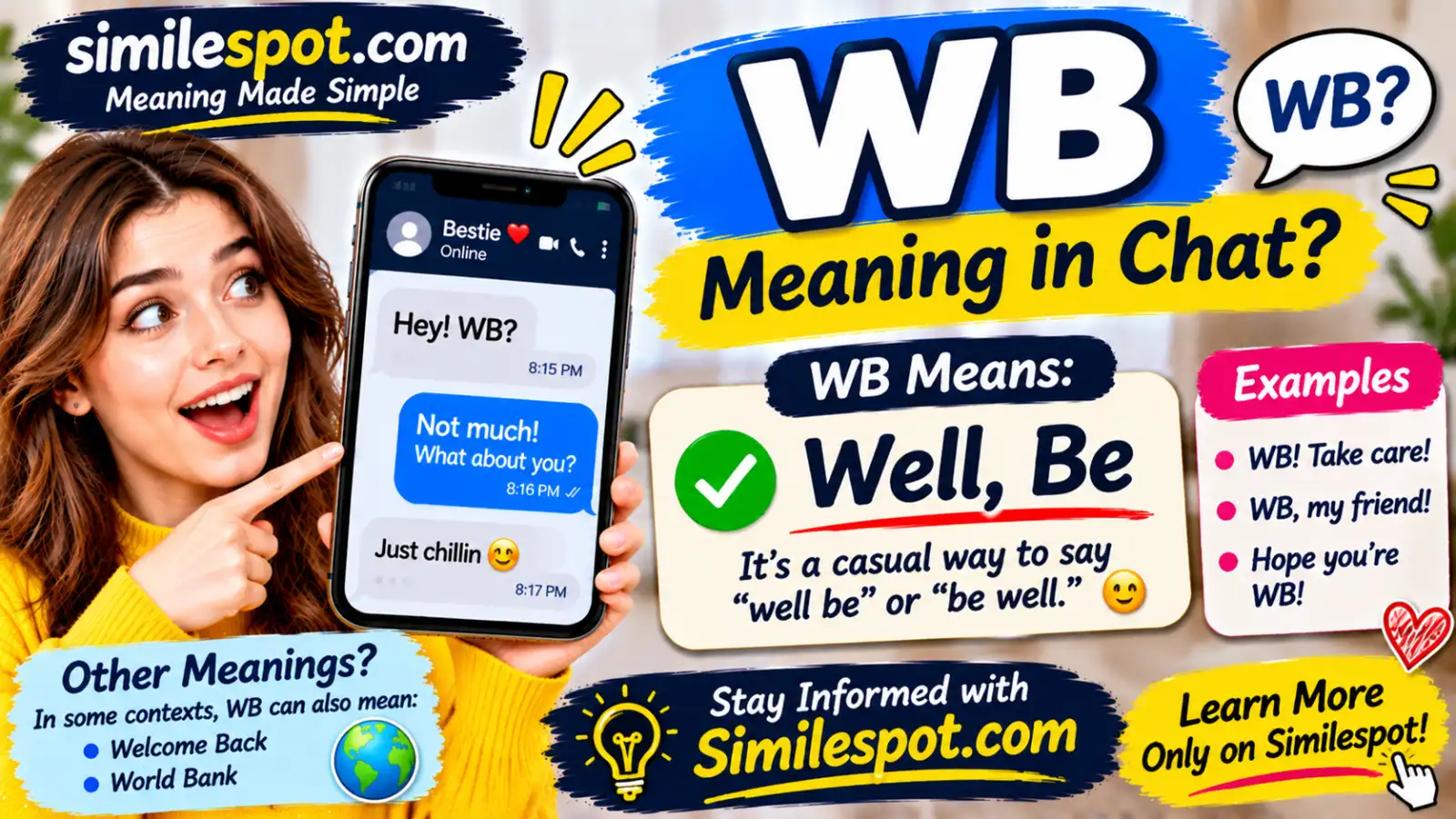
Have you ever received a short message containing “WB” and wondered what the sender was trying to say? Perhaps a friend sent it after you returned to a conversation, or someone used it in a group chat without explaining anything. Since texting is full of short forms and abbreviations, understanding every expression can sometimes feel confusing.
The WB meaning in chat most commonly refers to “Welcome Back.” People use it when someone returns to a conversation, joins a group again, or comes back after being away for a while. It is a quick and friendly way to acknowledge someone’s return.
For example:
Person A: Hey, I’m back!
Person B: WB! 😊
Here, WB simply means “Welcome Back.”
However, abbreviations can have different meanings depending on the conversation. In some situations, WB may stand for something else, such as “write back.” The surrounding words, platform, and relationship between the people can help you understand the intended meaning.
In this guide, we will explore what WB means in texting, how people use it on messaging platforms, where it comes from, and how to respond when someone sends it. You will also discover practical examples, related abbreviations, and common mistakes to avoid.
Let’s break it down! 👇
1. WHAT DOES WB MEAN IN CHAT? 🤔
WB most commonly means “Welcome Back” in online chats and text messages. It is a friendly abbreviation used to greet someone who has returned after being away.
People often use it in conversations when a friend comes back online, a group member rejoins a discussion, or someone returns after taking a break.
Instead of typing the complete phrase, they write two letters: WB.
Simple definition
WB = Welcome Back
It communicates a friendly greeting and acknowledges that someone has returned.
For example:
- Your friend returns to a group chat: “WB!”
- Someone comes back after dinner: “Hey, WB!”
- A gaming friend rejoins a session: “WB, ready to play?”
- A classmate returns to an online study group: “WB! We were just discussing the homework.”
The abbreviation is short, easy to understand, and suitable for casual digital conversations.
What feelings can WB communicate?
Depending on the situation, WB may express:
- Friendliness: The sender is happy to see someone return.
- Warmth: The sender wants to make the returning person feel included.
- Acknowledgment: The sender has noticed that someone is back.
- Excitement: The sender is pleased that the person has returned.
- Casual politeness: The sender wants to greet someone without writing a long message.
Quick meaning table
| Abbreviation | Full form | Meaning |
|---|---|---|
| WB | Welcome Back | Greeting someone who has returned |
| WB | Write Back | Asking someone to reply |
| BRB | Be Right Back | Saying you will return soon |
| BBL | Be Back Later | Saying you will return later |
| WBU | What About You? | Asking about another person |
| BTW | By The Way | Introducing additional information |
The most important thing to remember is that Welcome Back is a common interpretation of WB in casual chat, but context still matters.
2. DIFFERENT MEANINGS OF WB IN TEXTING AND ONLINE CONVERSATIONS 📱
Although “Welcome Back” is a common meaning, WB can have other interpretations in particular conversations.
This is why you should avoid assuming that every message containing WB means the same thing.
Let’s explore some possible meanings.
1. Welcome Back
This is a common interpretation in casual texting.
Someone may send WB when you return to a conversation after being away.
Example:
You: Sorry, I had to leave for a while.
Friend: No worries, WB!
2. Write Back
In some personal messages, WB may be used as a shortened way of asking someone to write back.
It can communicate that the sender wants a response.
Example:
Person A: I’ll send you the details later. WB when you get a chance.
Meaning: Write back when you have time.
This interpretation is less universal, so the surrounding sentence is important.
3. Other context-specific meanings
In some communities, workplaces, games, or personal conversations, WB may have a specialized meaning.
For example, someone may use an abbreviation that is familiar only to their group. It might refer to a project, a username, a game-related term, or an inside joke.
These meanings should not automatically be treated as standard texting definitions.
How can you identify the correct meaning?
Look at the message structure.
| Example message | Likely meaning |
|---|---|
| “Hey, WB!” | Welcome Back |
| “WB! We missed you.” | Welcome Back |
| “Please WB soon.” | Possibly Write Back |
| “Glad you’re here again, WB!” | Welcome Back |
| “Send the information and WB.” | Possibly Write Back, depending on context |
A useful rule
If WB appears as a greeting after someone returns, it probably means Welcome Back.
If it appears as an instruction asking someone to respond, it may mean Write Back.
When the meaning is unclear, asking the sender is better than guessing.
3. HOW IS WB USED IN EVERYDAY TEXT MESSAGES? 💬
Text messaging is one of the easiest places to encounter short abbreviations. People often prefer quick expressions because they make conversations faster and more convenient.
WB fits naturally into these conversations because it communicates a complete greeting using only two letters.
When a friend returns online
Imagine that your friend was offline for several hours. When they return and send a message, you might respond:
“WB! What’s new?”
This is a friendly way to restart the conversation.
When someone returns after a break
People sometimes step away from their phones to eat, study, work, or complete other activities.
Example:
Person A: I’m going to have dinner. BRB later.
Person B: Okay!
😀Person A: I’m back now.
Person B: WB! 😊
Here, WB acknowledges the person’s return.
When someone rejoins a group conversation
Group chats often include people who come and go throughout the day.
Example:
Person A: Sorry, my internet stopped working.
Person B: WB! We were talking about the weekend plans.
The abbreviation makes the conversation feel welcoming.
When someone returns after being busy
Example:
Friend A: I’ve been busy with exams lately.
Friend B: WB! Hope your exams went well.
This example shows how WB can be combined with a more personal greeting.
Common texting examples
- “WB! How have you been?”
- “Hey, welcome back!”
- “WB, we were waiting for you.”
- “Good to see you again, WB!”
- “WB! Ready to continue?”
- “WB! Did you finish your work?”
Why do people use WB instead of writing the full phrase?
There are several simple reasons:
- It saves typing time.
- It makes casual conversations quicker.
- It is easy to recognize in familiar groups.
- It fits naturally into short replies.
- It gives messages a relaxed digital tone.
However, you do not have to use WB to communicate naturally. Writing “Welcome back” is equally correct and may be clearer when someone is unfamiliar with the abbreviation.
4. WB MEANING ON SNAPCHAT, WHATSAPP, INSTAGRAM, AND OTHER PLATFORMS 📲
WB can appear on different messaging and social media platforms. Its general interpretation often stays the same, but the situations in which people use it can vary.
Let’s look at some common examples.
WB on Snapchat
Snapchat conversations are often short and casual. People use abbreviations to respond quickly to friends and keep conversations moving.
If someone returns after being inactive, a friend might send:
“WB! Where have you been?”
Here, WB means Welcome Back.
It can also appear in a group conversation when someone returns to the chat.
WB on WhatsApp
WhatsApp supports individual messages and group conversations, making it a natural place for abbreviations.
For example:
Person A: Sorry, I was busy with work.
Person B: No problem, WB!
The sender is welcoming the other person back into the conversation.
In a family or study group, someone might also write:
“WB everyone! Let’s continue.”
WB on Instagram
Instagram users may use WB in direct messages or informal comments.
For example:
Friend A: I’m finally active again!
Friend B: WB! Missed your updates.
The abbreviation helps create a friendly and relaxed tone.
WB in online gaming chats
Gaming communities often use short expressions because players need to communicate quickly.
If a teammate leaves a game temporarily and then returns, another player may say:
“WB! Ready for another round?”
This is a natural use of Welcome Back.
WB in online communities and forums
People also use WB in discussion groups, learning communities, and online forums.
For example:
“WB to the discussion! We have a few new updates.”
It acknowledges that someone has returned to an ongoing conversation.
Platform comparison
| Platform | Example | Likely meaning |
|---|---|---|
| Snapchat | “WB! How are you?” | Welcome Back |
| “WB to the group!” | Welcome Back | |
| “WB! Missed your posts.” | Welcome Back | |
| Gaming chat | “WB, ready?” | Welcome Back |
| Online forum | “WB to the discussion.” | Welcome Back |
Remember: The platform alone does not determine what WB means. The words around it provide the strongest clues.
5. ORIGIN AND EVOLUTION OF WB IN DIGITAL COMMUNICATION 🕰️
To understand why people use WB, it helps to look at the development of internet abbreviations.
Before smartphones became common, people already used shortened expressions in text messages and online conversations. Early mobile messaging often involved character limits, slower typing methods, and a preference for brief communication.
As a result, users developed abbreviations that allowed them to communicate familiar expressions with fewer characters.
Why did chat abbreviations become popular?
There were several reasons:
1. Limited message space
Older messaging systems sometimes placed restrictions on message length. Shortened expressions helped users communicate while saving characters.
2. Faster typing
Typing on early mobile phone keypads could take time. Short forms reduced the number of letters people needed to enter.
3. Online communities
Chat rooms, gaming groups, and internet forums encouraged quick communication. Users developed shared expressions that regular members could understand.
4. Informal communication
As digital conversations became more casual, abbreviations became part of everyday online language.
How did WB become familiar?
“Welcome Back” is a natural greeting for someone returning to a conversation. Shortening it to WB follows the same pattern as other digital expressions.
For example:
- BRB = Be Right Back.
- BBL = Be Back Later.
- TTYL = Talk To You Later.
- WB = Welcome Back.
These expressions help users communicate familiar ideas quickly.
Is there one known inventor of WB?
There is no single widely established inventor of the WB abbreviation in everyday texting. It developed as part of the broader habit of shortening common phrases in digital communication.
Does WB still have a place in modern texting?
Yes. Even though modern phones make typing easier, abbreviations remain popular because people enjoy quick and informal communication.
WB is still understandable in many casual settings, especially when the conversation makes its meaning clear.
6. REAL-LIFE EXAMPLES OF WB IN DIFFERENT CONVERSATIONS 🗨️
Examples make it easier to understand how an abbreviation works in everyday situations.
Here are original conversations showing different ways people may use WB.
Example 1: Returning after being offline
Person A: Sorry, my phone battery died.
Person B: WB! I thought you disappeared.
Meaning: Welcome Back.
Example 2: Returning to a group chat
Person A: Hey, everyone! I’m back.
Person B: WB! We were just talking about the trip.
Meaning: Welcome Back.
Example 3: Returning after studying
Person A: Finished studying for today.
Person B: WB to the chat! How did it go?
Meaning: Welcome Back.
Example 4: Returning to an online game
Player A: Had to restart my computer.
Player B: WB! Let’s continue.
Meaning: Welcome Back.
Example 5: Asking someone to respond
Person A: I sent you the project details. WB when you have time.
Possible meaning: Write Back.
This example uses WB differently. The request to respond helps suggest the intended meaning.
Example 6: A friendly conversation
Friend A: I haven’t been online all weekend.
Friend B: WB! Hope you had a good weekend.
Meaning: Welcome Back.
Example 7: Returning to a study group
Student A: My internet is working again.
Student B: WB! We saved your place in the discussion.
Meaning: Welcome Back.
Example 8: Returning after a short break
Person A: Back from lunch.
Person B: WB! Ready to finish the task?
Meaning: Welcome Back.
Example 9: A social media conversation
Person A: Finally posted something after weeks!
Person B: WB to Instagram! 😄
Meaning: Welcome Back.
Example 10: A message requesting a reply
Person A: Let me know what you think about the invitation. WB soon.
Possible meaning: Write Back soon.
The exact interpretation depends on how the people involved use abbreviations.
Example summary
| Situation | Message | Interpretation |
|---|---|---|
| Returning online | “WB!” | Welcome Back |
| Rejoining a group | “WB to the chat!” | Welcome Back |
| Returning to gaming | “WB, teammate!” | Welcome Back |
| Asking for a reply | “WB when free.” | Possibly Write Back |
| Returning from lunch | “WB! Let’s continue.” | Welcome Back |
These examples show why the surrounding sentence matters when interpreting short forms.
7. HOW TO REPLY WHEN SOMEONE SAYS WB 😊
If someone sends you WB, they are usually welcoming you back. You can respond with a simple thank-you or continue the conversation naturally.
Your reply does not need to be complicated.
Short and simple replies
- Thanks!
- Thank you!
- Thanks, I’m back.
- Good to be back!
- Appreciate it!
Friendly replies
- Thanks! What did I miss?
- Haha, I’m back!
- Thanks! How’s everyone doing?
- Good to see you all again!
- Thanks! Let’s continue.
Funny and playful replies
If you are chatting with close friends, a little humor can make the conversation more enjoyable.
- Haha, did you miss me?
- The legend has returned!
- I’m back in action!
- Thanks! The break is over.
- Finally made it back!
Use playful responses only when they match your relationship and the tone of the conversation.
Replies in a group chat
If someone welcomes you back to a group, you might say:
- Thanks, everyone!
- Hey! What’s happening?
- Thanks! Catch me up.
- Good to be back with you all.
- Thanks! I hope I didn’t miss anything important.
Replies when WB means Write Back
If the context suggests that someone is asking you to write back, respond according to their request.
For example:
Person A: Please WB when you can.
Person B: Sure, I’ll reply later today.
Quick response guide
| Situation | Suitable reply |
|---|---|
| Friend welcomes you back | “Thanks! 😊” |
| Group welcomes you | “Thanks, everyone!” |
| Gaming teammate welcomes you | “Thanks! Ready to play.” |
| Someone asks you to reply | “Sure, I’ll get back to you.” |
| Close friend jokes with you | “Haha, I’m back!” |
Tip: Match your reply to the conversation. A simple “Thanks!” is enough in most situations.
8. DIFFERENCE BETWEEN WB, BRB, BBL, AND OTHER CHAT ABBREVIATIONS 🔤
WB is part of a larger group of abbreviations used in online communication.
Some of these expressions look similar because they relate to returning or continuing a conversation. However, their meanings are different.
WB vs. BRB
- WB: Welcome Back.
- BRB: Be Right Back.
WB is generally used to greet someone who has returned. BRB is used when someone says they will leave temporarily and return soon.
Example:
Person A: BRB, getting some water.
😀Person A later: I’m back.
Person B: WB!
WB vs. BBL
- WB: Welcome Back.
- BBL: Be Back Later.
BBL tells someone that the sender plans to return at a later time. WB welcomes someone who has already returned.
WB vs. WBU
- WB: Commonly Welcome Back.
- WBU: What About You?
WBU is a question used to ask another person about their situation or opinion.
Example:
Person A: I’m doing great. WBU?
Person B: I’m good too!
WB vs. TTYL
- WB: Welcome Back.
- TTYL: Talk To You Later.
TTYL is often used when ending a conversation temporarily.
WB vs. WELCOME
“Welcome” is a general greeting. “Welcome Back” specifically acknowledges that someone has returned.
Comparison table
| Abbreviation | Full form | When to use it |
|---|---|---|
| WB | Welcome Back | When someone returns |
| BRB | Be Right Back | When leaving briefly |
| BBL | Be Back Later | When returning later |
| WBU | What About You? | When asking about someone |
| TTYL | Talk To You Later | When ending a conversation |
| BTW | By The Way | When adding information |
| FYI | For Your Information | When sharing useful information |
| GTG | Got To Go | When leaving a conversation |
Knowing these differences can make online communication easier and help prevent misunderstandings.
9. IS WB FORMAL OR INFORMAL? WHEN SHOULD YOU USE IT? 🤝
WB is generally an informal abbreviation. It is most suitable for casual messages, friendly group chats, gaming conversations, and everyday online communication.
Although people may understand it in professional digital conversations, writing the full phrase is often a better choice when communicating formally.
When WB is appropriate
You can comfortably use WB with:
- Close friends.
- Family members.
- Classmates.
- Gaming teammates.
- Members of casual online communities.
- People who regularly use texting abbreviations.
Example:
“WB! How was your trip?”
This sounds natural in a casual conversation.
When should you write “Welcome Back” instead?
Use the complete expression when:
- Writing a professional email.
- Communicating with a client.
- Welcoming a new employee.
- Addressing someone you do not know well.
- Writing a formal announcement.
- Communicating in an academic setting.
Professional example:
“Welcome back to the team. We look forward to working with you again.”
This sounds clearer and more polished than simply writing WB.
Formal vs. informal comparison
| Situation | Recommended wording |
|---|---|
| Texting a close friend | WB! |
| Group chat | Welcome back, everyone! or WB! |
| Workplace email | Welcome back to the team. |
| Client communication | It is good to have you back. |
| Gaming chat | WB, let’s play! |
| Academic discussion | Welcome back to the discussion. |
Does using WB make you sound rude?
Not usually. In a casual conversation, it is generally a friendly greeting.
However, a person unfamiliar with the abbreviation might not understand it. In that situation, writing the complete phrase is more considerate.
The best approach: Use abbreviations when they make communication easier, not when they make your message confusing.
10. COMMON MISTAKES AND MISUNDERSTANDINGS ABOUT WB ⚠️
Short abbreviations can be useful, but they can also create confusion when people interpret them differently.
Here are some common mistakes to avoid.
Mistake 1: Assuming WB always means Welcome Back
Welcome Back is a common meaning, but the abbreviation may have another meaning in a particular sentence.
For example:
“WB when you get a chance.”
Here, the sender may mean “Write Back.”
How to avoid it: Read the entire message before deciding what the abbreviation means.
Mistake 2: Confusing WB with BRB
These abbreviations communicate different things.
- WB welcomes someone who has returned.
- BRB tells someone that the sender will return soon.
They are not interchangeable.
Mistake 3: Using WB in a formal email
A professional message should be clear and appropriate for its audience.
Instead of:
“WB to the office!”
Write:
“Welcome back to the office!”
Mistake 4: Assuming WB has a hidden romantic meaning
Someone sending WB is usually just welcoming you back. The abbreviation does not automatically indicate romantic interest.
How to avoid it: Interpret the message according to the relationship and conversation.
Mistake 5: Using abbreviations with people who may not understand them
Not everyone knows internet slang. Some people prefer complete words and sentences.
If you are unsure, write “Welcome Back” instead.
Mistake 6: Overusing abbreviations
A message filled with unfamiliar short forms can become difficult to understand.
For example, a sentence containing several unexplained abbreviations may confuse someone who does not use them regularly.
Better approach: Use familiar expressions and keep your message easy to read.
Mistake 7: Ignoring the tone of the conversation
Even a friendly abbreviation may feel unusual in a serious conversation.
Consider the situation before using it. Sometimes a thoughtful full sentence is more appropriate than a two-letter response.
11. WHY DO PEOPLE USE WB INSTEAD OF WELCOME BACK? ⚡
People use WB because short forms make digital conversations faster and more convenient.
Although typing the complete phrase is not difficult on modern devices, abbreviations remain popular because they are familiar, simple, and easy to recognize.
It saves time
Typing two letters takes less time than writing the complete expression.
This can be helpful in active group chats where messages arrive quickly.
It creates a casual tone
WB feels relaxed and informal. It fits naturally into conversations between people who already know each other.
It is easy to remember
The abbreviation uses the first letters of the two words in “Welcome Back.” This makes it relatively simple to understand once someone learns the expression.
It works in short replies
Sometimes, a person only needs to acknowledge someone’s return.
For example:
Friend: I’m back!
You: WB!
The response is short but understandable.
It is common in online communities
People who regularly participate in gaming groups, chat rooms, and online communities often become familiar with abbreviations.
Using familiar short forms can make conversations feel quicker and more natural.
Should you always use WB?
No. The full phrase is just as useful.
Use WB when the conversation is casual and the other person understands it. Choose “Welcome Back” when clarity or formality matters more.
FAQs:
1. What does WB mean in chat?
WB most commonly means Welcome Back in casual online conversations. People use it to greet someone who has returned after being away from a chat, group, or online activity. In some contexts, it may also mean “Write Back.”
2. What does WB mean from a girl or a guy?
The abbreviation has no special gender-based meaning. A girl or a guy may use WB simply to say Welcome Back. The intended meaning depends on the conversation, not the sender’s gender.
3. What does WB mean on Snapchat?
On Snapchat, WB commonly means Welcome Back. Someone may send it when a friend returns to a conversation or becomes active again. It is generally a casual and friendly greeting.
4. How do you reply to WB in a text?
You can reply with “Thanks!”, “Good to be back!”, “Thanks! What did I miss?” or “I’m back!” Choose a response that matches the tone of your conversation.
5. Is WB the same as BRB?
No. WB usually means Welcome Back, while BRB means Be Right Back. WB welcomes someone who has returned, whereas BRB tells someone that you will return shortly.
FINAL THOUGHTS:
Understanding the WB meaning in chat is simple once you know the context. In most casual conversations, WB stands for Welcome Back. It is a short, friendly way to greet someone who has returned after being away.
You may see it on Snapchat, WhatsApp, Instagram, gaming platforms, and online discussion groups. In certain situations, WB can also mean “Write Back,” especially when someone is asking for a response.
Remember these key points:
- WB most commonly means Welcome Back.
- It is generally used in informal digital conversations.
- It can express friendliness and acknowledgment.
- Its meaning may change depending on the sentence.
- It is different from BRB, BBL, and WBU.
- Writing the complete phrase is better in formal communication.
The next time someone sends you WB, you will have a much clearer idea of what they mean. Just consider the conversation and respond naturally.
CTA: Want to understand more texting abbreviations and online slang? Explore our related meaning guides to discover what popular chat expressions mean and how to use them confidently in everyday conversations.

I am a passionate writer at SimileSpot who loves playing with words. I create clear and creative similes to make ideas easy to understand and fun to read.