
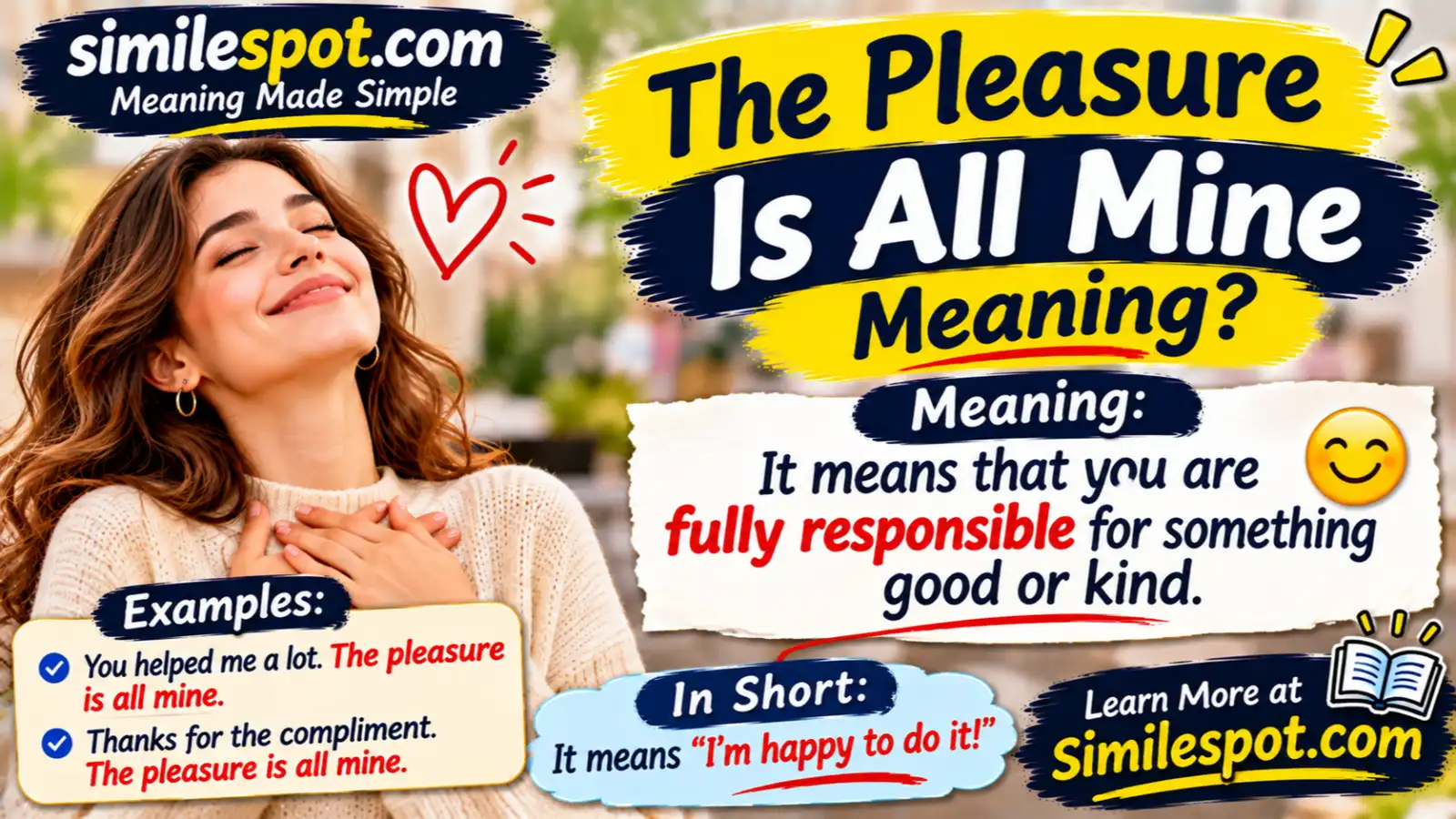
Have you ever met someone, exchanged a few friendly words, and heard them say, “The pleasure is all mine”? It sounds warm, respectful, and slightly formal. However, if you’re unfamiliar with the expression, you might wonder what the person actually means or how you should respond.
Understanding the pleasure is all mine meaning can help you communicate more confidently in social situations, professional meetings, emails, and everyday conversations.
In simple words, “The pleasure is all mine” means that meeting, helping, or interacting with someone has been a genuine pleasure for you. It is a polite way to express appreciation, return a compliment, or show that you enjoyed an interaction.
For example, imagine meeting a new colleague. After introducing yourselves, you say, “It’s a pleasure to meet you.” They respond, “The pleasure is all mine.” They’re simply communicating that they’re equally happy to meet you.
This expression isn’t limited to introductions. People also use it when someone thanks them for their help, kindness, hospitality, or time.
In this guide, we’ll explore the meaning, origin, correct usage, real-life examples, alternative expressions, and appropriate responses. You’ll also learn how to use this phrase naturally without sounding overly formal.
Let’s get started! 😊
1. What Does The Pleasure Is All Mine Mean?
The pleasure is all mine is a polite expression that communicates genuine enjoyment, appreciation, or gratitude.
People commonly use it when responding to someone who expresses pleasure in meeting them, receiving their assistance, or spending time with them.
It essentially means:
- I enjoyed meeting you too.
- I’m equally happy to have met you.
- Helping you was my pleasure.
- I appreciated the opportunity to interact with you.
- I’m glad I could make your experience enjoyable.
The expression is particularly useful because it turns a simple exchange of compliments into a warmer interaction.
Simple Definition
| Expression | Meaning |
|---|---|
| The pleasure is all mine | I’m equally pleased or happy. |
| Pleasure to meet you | I’m happy to meet you. |
| It was my pleasure | I was happy to help. |
| The pleasure is mine | I’m pleased to meet or assist you. |
A Simple Conversation Example
Person A: It was wonderful meeting you today.
Person B: The pleasure is all mine!
In this conversation, Person B returns the positive feeling and communicates that the meeting was enjoyable for them too.
Why Do People Use This Expression?
There are several reasons people choose this phrase:
- Politeness: It shows good manners.
- Appreciation: It communicates that an interaction was valuable.
- Friendliness: It creates a warm impression.
- Respect: It acknowledges another person’s kindness or presence.
- Professionalism: It helps maintain courteous communication.
The phrase is especially useful when you want to sound appreciative without using complicated language.
2. The Origin and Background of The Pleasure Is All Mine
The expression “The pleasure is all mine” comes from the traditional use of the word pleasure to describe enjoyment, satisfaction, or happiness.
The phrase developed as a courteous response in English-speaking social interactions.
Historically, polite expressions played an important role in introductions, hospitality, business relationships, and formal conversations.
People used phrases such as “It is my pleasure” and “The pleasure is mine” to communicate appreciation and good manners.
Over time, these expressions became familiar parts of everyday English.
Understanding the Words
Let’s break the expression into smaller parts.
The: Identifies the particular pleasure being discussed.
Pleasure: Refers to enjoyment, happiness, or satisfaction.
Is: Connects the subject with its description.
All: Adds emphasis, suggesting that the pleasure belongs entirely to the speaker.
Mine: Indicates that the speaker personally experienced the enjoyment.
Together, these words create a polite expression that communicates mutual appreciation.
How Its Usage Has Changed
The phrase is now used in several situations:
- Traditional introductions: Responding politely after meeting someone.
- Business communication: Showing appreciation after a professional interaction.
- Everyday conversations: Returning a friendly compliment.
- Customer service: Responding warmly when someone thanks you.
- Social occasions: Expressing happiness after meeting or helping someone.
Although the expression has a traditional tone, it remains useful in modern English.
It can sound natural in both professional and personal conversations when used appropriately.
3. When and Why Do People Say The Pleasure Is All Mine?
Understanding when to use this expression is just as important as knowing its definition.
The phrase generally appears when someone wants to return a positive statement or acknowledge an enjoyable interaction.
Here are some common situations where it fits naturally.
A. When Meeting Someone for the First Time
This is one of the most recognizable uses.
When someone says, “It’s a pleasure to meet you,” you can respond with “The pleasure is all mine.”
Example:
Alex: It’s wonderful to finally meet you.
Jordan: The pleasure is all mine!
The response communicates that you’re equally pleased about the introduction.
B. When Someone Thanks You for Helping Them
You can also use the expression when someone appreciates your assistance.
Example:
Emma: Thank you so much for helping me prepare the presentation.
Sophie: The pleasure is all mine. I’m glad I could help.
Here, the phrase communicates that helping Emma was enjoyable rather than a burden.
C. After a Professional Meeting
Business meetings often include polite exchanges before or after discussions.
Example:
Client: It was a pleasure discussing this project with you.
Professional: The pleasure is all mine. I enjoyed our conversation.
This response creates a respectful and positive impression.
D. When Someone Compliments Your Hospitality
Imagine that you invite someone to dinner or organize a small gathering.
Afterward, they thank you for making the experience enjoyable.
Example:
Guest: Thank you for inviting me. I had a wonderful evening.
Host: The pleasure is all mine. I’m glad you enjoyed it.
This makes the guest feel appreciated.
E. When Meeting a New Colleague
A workplace introduction is another suitable opportunity.
Example:
Colleague: I’m glad we finally got a chance to meet.
You: The pleasure is all mine. I look forward to working together.
This response sounds friendly while maintaining professionalism.
Quick Summary
| Situation | Why People Use It |
|---|---|
| First meeting | Returning a polite greeting |
| Helping someone | Showing appreciation |
| Business meeting | Maintaining professionalism |
| Social gathering | Expressing mutual enjoyment |
| Workplace introduction | Building a friendly relationship |
| Receiving thanks | Communicating that helping was enjoyable |
The main purpose is to make another person feel that their presence or interaction was appreciated.
4. Real-Life Examples of The Pleasure Is All Mine
The easiest way to understand an expression is to see how people use it in realistic conversations.
Below are different examples that demonstrate the meaning and tone of this phrase.
Example 1: Meeting Someone New
Olivia: It’s a pleasure to meet you.
Daniel: The pleasure is all mine.
Meaning: Daniel is equally happy to meet Olivia.
Example 2: Helping a Friend
Mia: Thanks for helping me understand the assignment.
Emma: The pleasure is all mine. Anytime!
Meaning: Emma enjoyed helping her friend.
Example 3: Professional Introduction
Manager: I’m pleased to finally meet you.
Employee: The pleasure is all mine. I’ve heard great things about the team.
Meaning: The employee responds respectfully and positively.
Example 4: After a Business Discussion
Client: Thank you for taking the time to explain everything.
Consultant: The pleasure is all mine. I’m happy we could discuss your questions.
Meaning: The consultant appreciates the opportunity to help.
Example 5: Social Gathering
Guest: I had such a lovely time at your house.
Host: The pleasure is all mine. You’re welcome anytime!
Meaning: The host enjoyed having the guest.
Example 6: Receiving Appreciation
Colleague: I really appreciate your support during the project.
You: The pleasure is all mine. We make a great team.
Meaning: You enjoyed working together and appreciate the recognition.
Example 7: Networking Event
Professional A: It was great connecting with you today.
Professional B: The pleasure is all mine. I enjoyed learning about your work.
Meaning: Professional B expresses mutual appreciation.
Example 8: Helping a Customer
Customer: Thank you for making the process so easy.
Representative: The pleasure is all mine. We’re always happy to assist.
Meaning: The representative politely acknowledges the customer’s appreciation.
Example 9: Meeting a Teacher
Student: It’s wonderful to meet you, ma’am.
Teacher: The pleasure is all mine. Welcome to the class.
Meaning: The teacher responds warmly to the introduction.
Example 10: Reconnecting With Someone
Friend A: I’m so happy we finally got to see each other again.
Friend B: The pleasure is all mine. It’s been too long!
Meaning: Both people are happy to reconnect.
These examples demonstrate that the expression can fit many situations, provided the speaker genuinely wants to communicate appreciation or enjoyment.
5. How to Respond to The Pleasure Is All Mine
Sometimes, knowing the meaning isn’t enough. You might also want to know what to say when someone uses this expression with you.
Fortunately, responding is simple.
Your reply can be friendly, professional, casual, or appreciative depending on the conversation.
A. Friendly Responses
If you’re talking to a friend or someone you’ve recently met, you can use:
- “I’m glad we met!”
- “Likewise!”
- “It was wonderful meeting you too.”
- “I really enjoyed our conversation.”
- “Same here!”
- “I’m happy we got to connect.”
Example:
Person A: The pleasure is all mine!
Person B: Likewise! I really enjoyed meeting you.
B. Professional Responses
In a workplace or business setting, choose respectful and polished replies.
- “I appreciate that.”
- “It was wonderful speaking with you.”
- “I look forward to working together.”
- “Thank you. I enjoyed our discussion as well.”
- “I appreciate your time.”
- “Likewise. I hope we can collaborate again.”
Example:
Client: The pleasure is all mine.
You: Thank you. I look forward to working together.
C. Warm and Appreciative Responses
If someone helped you or made an interaction enjoyable, you can respond with:
- “That’s very kind of you.”
- “I truly appreciate it.”
- “I’m glad we had the opportunity to connect.”
- “It means a lot.”
- “Thank you for making me feel welcome.”
D. Short and Simple Responses
Sometimes, a short answer is all you need.
| Response | Tone |
|---|---|
| Likewise! | Friendly |
| Same here! | Casual |
| Absolutely! | Positive |
| Thank you! | Appreciative |
| I appreciate that! | Respectful |
| It was wonderful! | Warm |
| My pleasure too! | Friendly |
E. What If You Don’t Know What to Say?
You don’t need to create a complicated response.
A simple “Likewise!” usually works well when someone says the pleasure is all mine after an introduction.
For example:
Person A: The pleasure is all mine.
Person B: Likewise! It was great meeting you.
This keeps the conversation natural and comfortable.
6. Best Synonyms and Alternatives for The Pleasure Is All Mine
Although “The pleasure is all mine” is a lovely expression, repeating it frequently can make your conversations sound predictable.
Using different alternatives can make your communication more natural.
However, not every synonym works in every situation.
Some expressions are more formal, while others are friendly and conversational.
Here are some useful alternatives.
| Alternative | Meaning | Best Situation |
|---|---|---|
| Likewise | I feel the same way | Introductions |
| My pleasure | I was happy to help | Responding to thanks |
| The pleasure is mine | I’m equally pleased | Formal introductions |
| Happy to help | I enjoyed assisting you | Customer service |
| It was my honor | I feel privileged | Respectful situations |
| Glad to meet you | I’m happy we met | First meetings |
| Same here | I feel the same | Casual conversations |
| I enjoyed it too | I also had a good experience | Social situations |
| It was wonderful | The experience was enjoyable | Meetings |
| I’m delighted | I’m very pleased | Formal conversations |
| Always a pleasure | I consistently enjoy it | Familiar interactions |
| It was lovely | It was a pleasant experience | Friendly situations |
More Expressions Similar to The Pleasure Is All Mine
You can also use these alternatives:
- “Likewise, it was wonderful meeting you.”
- “I’m equally pleased.”
- “It was a privilege.”
- “I’m glad we had the opportunity to meet.”
- “I enjoyed our conversation.”
- “I’m happy I could assist.”
- “It was wonderful connecting with you.”
- “I’m delighted we could meet.”
- “The feeling is mutual.”
- “I’m equally grateful.”
- “I appreciated the opportunity.”
- “It was a lovely experience.”
- “I’m pleased to have helped.”
- “I’m glad we connected.”
- “I enjoyed every moment.”
Writing tip: Choose an alternative that matches the situation rather than simply selecting the most formal expression.
For instance, “My pleasure” is especially natural after someone thanks you for assistance, while “Likewise” is often more suitable after a friendly introduction.
7. Is The Pleasure Is All Mine Formal or Informal?
The expression “The pleasure is all mine” is polite and slightly formal, but it isn’t restricted to formal conversations.
You can use it in professional settings, social situations, and friendly interactions.
Its tone is generally warm, respectful, and appreciative.
However, the way it sounds can depend on your relationship with the other person.
Formal Situations
The phrase works particularly well in:
- Business meetings.
- Professional introductions.
- Networking events.
- Customer service conversations.
- Interviews.
- Academic meetings.
- Formal social gatherings.
Example:
“Thank you for meeting with us today.”
“The pleasure is all mine. I appreciate the opportunity.”
This response sounds professional and respectful.
Informal Situations
You can also use it when speaking with:
- Friends.
- Neighbors.
- New acquaintances.
- Classmates.
- Family friends.
- People you meet socially.
Example:
“Thanks for helping me with my project!”
“The pleasure is all mine. Glad I could help!”
Although it sounds slightly polished, it doesn’t feel inappropriate in a friendly conversation.
Formal vs. Informal Alternatives
| Formal Expression | Informal Expression |
|---|---|
| The pleasure is all mine. | Likewise! |
| It was my honor. | Happy to help! |
| I appreciate the opportunity. | Glad we met! |
| It was wonderful meeting you. | Great meeting you! |
| I’m delighted to assist. | No problem! |
| I enjoyed our discussion. | That was fun! |
Should You Use It in Emails?
Yes! The expression can work in professional emails, especially when responding to an introduction or thanking someone for an interaction.
For example:
“Thank you for taking the time to speak with me. The pleasure was all mine, and I look forward to staying connected.”
This sounds polite and professional.
However, you should avoid using overly formal expressions in every sentence. Natural writing is usually more effective than complicated wording.
8. The Difference Between The Pleasure Is All Mine, My Pleasure, and Likewise
These expressions are related, but they don’t always communicate exactly the same thing.
Understanding their differences will help you select the most appropriate phrase.
A. The Pleasure Is All Mine
This expression usually returns someone’s positive statement.
It suggests that the speaker is equally pleased about an interaction or experience.
Example:
Person A: It was wonderful meeting you.
Person B: The pleasure is all mine.
The speaker is communicating mutual enjoyment.
B. My Pleasure
“My pleasure” is commonly used when responding to someone’s thanks.
It communicates that helping or assisting the other person was enjoyable.
Example:
Person A: Thank you for helping me.
Person B: My pleasure!
The speaker is politely acknowledging the appreciation.
C. Likewise
“Likewise” means that you feel the same way or share the other person’s sentiment.
It is short, versatile, and suitable for both formal and casual conversations.
Example:
Person A: It’s great to meet you.
Person B: Likewise!
The second person returns the friendly sentiment.
Comparison Table
| Expression | Main Meaning | Common Usage |
|---|---|---|
| The pleasure is all mine | I’m equally pleased | Introductions and appreciation |
| My pleasure | I was happy to help | Responding to thanks |
| Likewise | I feel the same way | Greetings and compliments |
| The pleasure is mine | I’m equally happy | Polite introductions |
| Happy to help | I enjoyed assisting | Everyday communication |
| Same here | I share that feeling | Casual conversations |
Which One Is Best?
There isn’t one perfect expression for every situation.
Choose based on your intention:
- Meeting someone: The pleasure is all mine.
- Receiving thanks: My pleasure.
- Returning a greeting: Likewise.
- Offering assistance: Happy to help.
- Casual conversation: Same here.
Understanding these differences makes your English sound more natural and accurate.
9. Common Mistakes to Avoid When Using The Pleasure Is All Mine
Even though this expression is simple, some people use it in situations where another phrase would communicate their meaning more clearly.
Here are several common mistakes and ways to avoid them.
Mistake 1: Using It When You Actually Mean No Problem
If someone apologizes for a minor mistake, saying “The pleasure is all mine” may sound slightly unnatural.
For example:
Friend: Sorry I replied late.
You: The pleasure is all mine.
This doesn’t clearly answer the apology.
A more natural response would be:
“No worries! It’s completely fine.”
Tip: Use “The pleasure is all mine” when returning appreciation or acknowledging an enjoyable interaction.
Mistake 2: Confusing It With My Pleasure
Although the expressions are related, they have different common uses.
“My pleasure” usually responds to thanks.
“The pleasure is all mine” commonly returns someone’s positive statement.
Tip: Pay attention to what the other person said before choosing your response.
Mistake 3: Using It Too Frequently
Repeating the same phrase in every conversation can make your language sound mechanical.
Instead, try alternatives such as:
- Likewise.
- I’m glad we met.
- Happy to help.
- I enjoyed our conversation.
- It was wonderful connecting with you.
Tip: Use different expressions naturally without forcing variety.
Mistake 4: Using It in an Unnecessarily Formal Way
Some casual conversations don’t require polished expressions.
For example:
Friend: Thanks for sending me the picture.
You: The pleasure is all mine.
This is grammatically understandable, but “You’re welcome!” or “No problem!” may sound more natural.
Tip: Match your response to the tone of the conversation.
Mistake 5: Forgetting the Meaning of All
The word “all” adds emphasis to the expression.
It communicates that the pleasure belongs entirely to the speaker.
However, you don’t need to interpret it as a literal statement about ownership.
Tip: Understand the phrase as a polite expression of mutual appreciation.
Mistake 6: Using It Without Genuine Appreciation
The expression sounds best when it reflects a positive feeling.
If you’re communicating about an unpleasant or difficult situation, another phrase may be more suitable.
Tip: Choose words that honestly reflect your intention.
10. How to Use The Pleasure Is All Mine in Emails and Professional Writing
Professional emails require a balance between politeness, clarity, and friendliness.
The phrase can make a response sound warm, particularly after someone thanks you for a meeting or introduction.
Here are some examples of how to use it naturally.
A. After a Business Meeting
Example:
Subject: Thank You for the Meeting
“Thank you for taking the time to meet with me today. The pleasure was all mine, and I appreciated the opportunity to discuss our ideas. I look forward to staying in touch.”
B. After a Professional Introduction
Example:
“It was wonderful meeting you and learning more about your work. The pleasure is all mine, and I hope we have another opportunity to connect soon.”
C. When Responding to a Client
Example:
“Thank you for your kind words. The pleasure is all mine. We’re happy to support you and look forward to working together again.”
D. When Responding to a Colleague
Example:
“I appreciate your message. The pleasure was all mine, and I’m glad we could work together on this project.”
E. After a Networking Conversation
Example:
“It was a pleasure connecting with you. The pleasure is all mine, and I enjoyed hearing about your professional experience.”
Useful Email Alternatives
If you want to avoid repeating the same expression, consider these options:
- “I appreciated the opportunity to connect.”
- “It was wonderful speaking with you.”
- “I’m glad we had the chance to meet.”
- “I enjoyed our discussion.”
- “I’m happy I could assist.”
- “I look forward to future conversations.”
Professional Writing Tips
Keep your response relevant: Mention the meeting, assistance, or interaction that prompted your reply.
Avoid unnecessary repetition: You don’t need to use the phrase in every email.
Maintain a natural tone: Professional language should remain easy to understand.
Use appropriate wording: Select a response that reflects your actual relationship with the recipient.
A short, thoughtful sentence is often more effective than a lengthy formal response.
FAQs:
Here are answers to common questions about this expression and its use in everyday English.
1. What does the pleasure is all mine mean in simple words?
“The pleasure is all mine” means that you are equally happy or pleased about meeting, helping, or interacting with someone. It is a polite way to return appreciation or acknowledge an enjoyable experience.
2. What should I reply when someone says the pleasure is all mine?
You can respond with “Likewise,” “Same here,” “I enjoyed meeting you too,” or “I’m glad we connected.” In professional situations, “I appreciate that” is another suitable response.
3. Is the pleasure is all mine a formal expression?
Yes, it is generally considered polite and slightly formal. However, people also use it in friendly conversations. It is particularly appropriate for professional introductions, business meetings, networking, and situations involving mutual appreciation.
4. Is the pleasure is all mine the same as my pleasure?
They have related meanings but different common uses. “The pleasure is all mine” usually expresses mutual enjoyment after meeting or interacting with someone. “My pleasure” commonly responds to thanks and communicates that helping was enjoyable.
5. Can I use the pleasure is all mine in an email?
Yes! You can use it in professional emails when responding to someone after a meeting, introduction, or positive interaction. For example: “The pleasure was all mine. I appreciated the opportunity to discuss the project with you.”
Conclusion:
Understanding the pleasure is all mine meaning helps you communicate appreciation, friendliness, and respect in different situations.
The expression simply means that you are equally pleased about an interaction, whether you’ve met someone, helped them, attended a meeting, or enjoyed a conversation.
Here are the main points to remember:
- Meaning: It expresses mutual happiness, appreciation, or enjoyment.
- Common usage: People use it after introductions, meetings, and helpful interactions.
- Tone: It sounds polite, warm, and slightly formal.
- Responses: Likewise, same here, and I enjoyed it too are suitable alternatives.
- Synonyms: The pleasure is mine, happy to help, and I’m delighted are useful alternatives in appropriate situations.
The next time someone says, “It’s a pleasure to meet you,” you can confidently respond, “The pleasure is all mine!”
Remember, good communication isn’t just about choosing the right words. It’s also about making others feel respected and appreciated.
Want to improve your English vocabulary even further? Explore more helpful guides on everyday expressions, word meanings, and useful synonyms at SimileSpot. Discover new phrases and make every conversation more confident and natural! 🚀

I am a passionate writer at SimileSpot who loves playing with words. I create clear and creative similes to make ideas easy to understand and fun to read.