
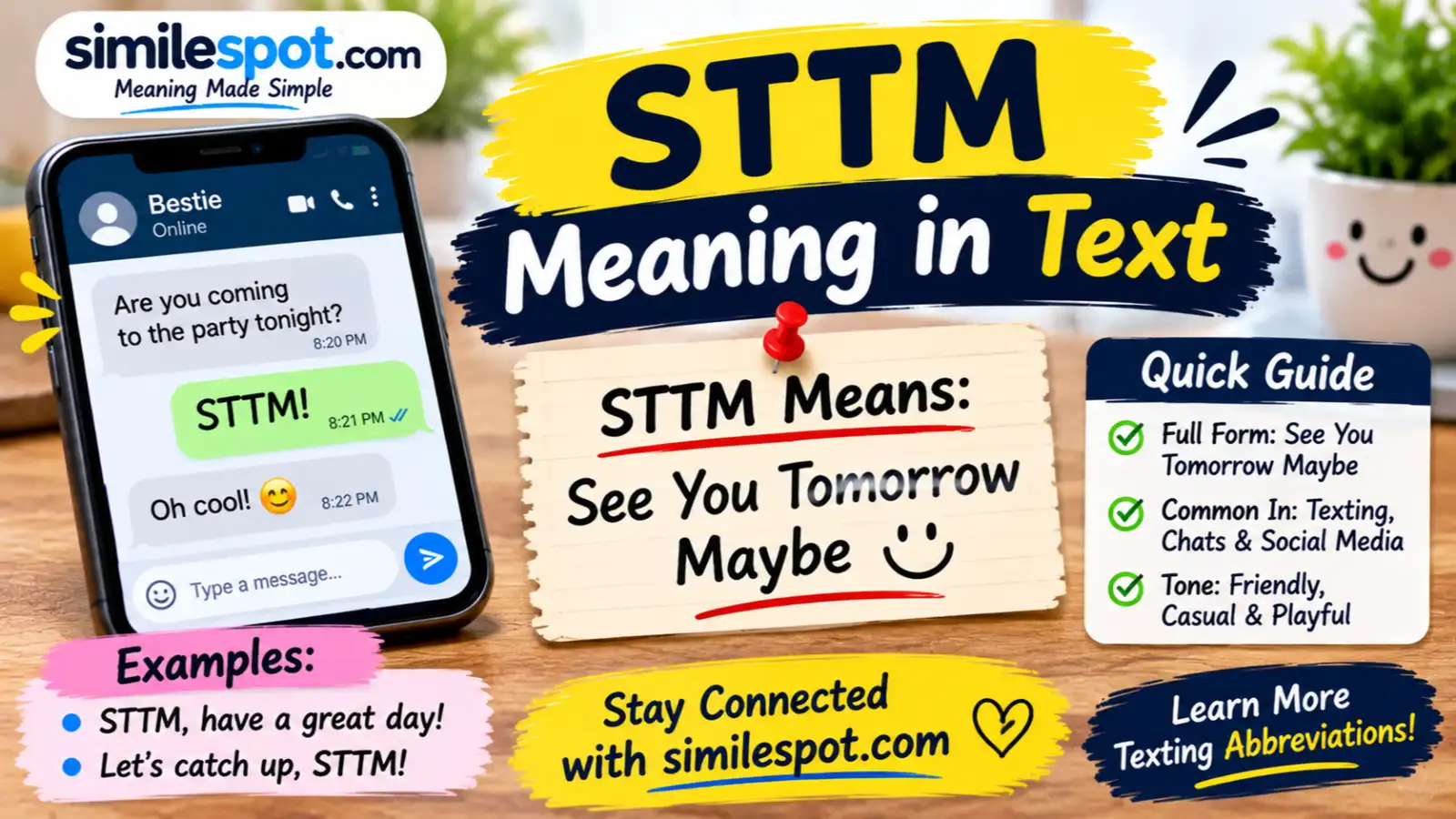
Have you ever received a short message containing STTM and wondered what the sender was trying to say? Texting abbreviations can make conversations quick and convenient, but unfamiliar combinations of letters can also leave you confused. If someone sends you STTM without explaining it, understanding the message may take a little detective work.
The STTM meaning in text is not fixed across all online conversations. One possible interpretation is “Stop Talking To Me,” especially when someone is expressing frustration or asking for space. However, this abbreviation is not universally standardized, so its meaning can depend on the sender, the conversation, and the platform.
That distinction matters. You should not automatically assume that every person who writes STTM means the same thing.
In this guide, you will learn about the possible meaning of STTM, how to recognize its tone, how people might use it in messages, and how to respond naturally. You will also discover related texting abbreviations and practical examples that make the expression easier to understand. 📱
1. What Does STTM Mean in Text? 💬
STTM may mean “Stop Talking To Me” in texting. In this interpretation, someone uses the abbreviation to communicate that they do not want to continue a conversation.
It can express irritation, frustration, or a desire for personal space. However, the exact meaning is not guaranteed because STTM does not have one widely recognized definition in everyday texting.
For example:
Person A: Why are you still arguing about this?
Person B: STTM. I don’t want to discuss it anymore.
In this example, the sender appears to be ending the conversation.
Another possible exchange:
Person A: Can we talk about what happened?
Person B: Not right now. STTM.
Here, the abbreviation may communicate that the sender wants the other person to stop messaging for the moment.
Quick definition
| Term | Explanation |
|---|---|
| Abbreviation | STTM |
| Possible expansion | Stop Talking To Me |
| General category | Texting abbreviation |
| Possible tone | Frustrated, direct, or serious |
| Main purpose | Asking someone to stop talking or messaging |
| Usage | Depends on context and the sender |
Important: STTM is not as widely established as common abbreviations such as LOL or BRB. If its meaning is unclear, consider asking the sender what they intended.
2. Understanding the Possible Meaning of STTM 🔍
When someone sends STTM, the surrounding conversation provides important clues.
If the discussion involves an argument, repeated messages, or an uncomfortable topic, “Stop Talking To Me” may be a reasonable interpretation.
However, context matters more than the letters alone.
A request to end a conversation
The sender may want the discussion to stop.
For example:
Friend: You need to explain what happened yesterday.
You: I already explained everything.
Friend: STTM.
The sender may be frustrated and unwilling to continue discussing the issue.
A request for personal space
Sometimes people need time away from a conversation. They may use a short expression to communicate that preference.
For example:
Person A: Are you ready to talk?
Person B: STTM for now. I need some space.
In this situation, the message communicates a temporary boundary rather than necessarily ending the relationship.
A reaction during an argument
STTM may also appear during a heated exchange.
For example:
Person A: You keep changing your story.
Person B: STTM. This conversation is going nowhere.
The abbreviation makes the sender’s frustration clear, although the full emotional meaning depends on the conversation.
Could STTM mean something else?
Yes. People sometimes create personal abbreviations, use group-specific expressions, or type combinations of letters that have meaning only to their friends.
A sender might also make a typing mistake.
Therefore, if “Stop Talking To Me” does not fit the conversation, do not force that interpretation. Ask what the sender means.
3. How Is STTM Used in Text Messages? 📲
If someone uses STTM to mean “Stop Talking To Me,” the expression usually appears when they want a conversation to end.
It may occur in private messages, group chats, or conversations on social platforms.
Here are some situations where this interpretation could make sense.
During a disagreement
People sometimes use short expressions when they feel frustrated.
Example:
Alex: You misunderstood what I said.
Sam: I don’t want another argument.
Alex: STTM.
The sender may be asking the other person to stop continuing the discussion.
When someone keeps sending messages
A person might use the abbreviation when they feel overwhelmed by repeated messages.
Example:
Mia: Are you there?
😀Mia: Hello?
Mia: Can you answer?
Jordan: STTM. I’ll reply when I’m ready.
Here, the sender is communicating a need for space.
When someone wants privacy
A conversation may involve a personal topic that the sender does not want to discuss.
Example:
Friend: Why haven’t you told anyone about your plans?
You: It’s personal.
Friend: STTM?
In this example, the abbreviation is less clear. The sender may have mistyped something or may be using a personal shorthand. Asking for clarification is better than guessing.
In a casual conversation
Some friends use direct expressions jokingly. Still, STTM can sound harsh, so it is important not to assume that the sender is joking.
Example:
Friend A: I have sent you five pictures of my new shoes.
Friend B: STTM 😂
This could be playful teasing between friends who understand each other’s humor. Without that shared context, it might sound unfriendly.
4. STTM Meaning in Different Chat Situations 🎭
The same abbreviation can communicate different things depending on the conversation.
The following examples show how context can affect interpretation.
| Chat Situation | Possible Interpretation | What to Consider |
|---|---|---|
| Argument | Stop talking to me | The sender may be frustrated |
| Repeated messages | Stop messaging me | The sender may need space |
| Personal discussion | End this conversation | The topic may feel uncomfortable |
| Friendly teasing | A playful request to stop | Look at the relationship and tone |
| Unclear conversation | Unknown personal abbreviation | Ask the sender |
| Group chat | Request to stop a discussion | Consider what happened before the message |
The importance of tone
Text messages do not always communicate emotion clearly.
A short abbreviation may sound angry even when the sender is simply tired or trying to end a conversation quickly.
For example:
- “STTM.” may sound firm or irritated.
- “Please stop messaging me for now.” communicates a similar boundary in clearer language.
- “Let’s talk later.” expresses a desire to pause without sounding as direct.
The punctuation, previous messages, and relationship between the people involved can all influence how a message feels.
Do not rely on capitalization alone
STTM is usually written in capital letters because it is an abbreviation. Capital letters do not automatically mean that someone is shouting.
Look at the full message rather than judging its tone from capitalization alone.
5. Realistic Examples of STTM in Text Conversations 🗨️
Examples make unfamiliar abbreviations easier to understand.
Below are several fictional conversations showing how STTM might appear if the sender intends “Stop Talking To Me.”
Example 1: During an argument
Taylor: You never listen to what I say.
Morgan: I am trying to understand your point.
Taylor: STTM. I don’t want to argue anymore.
Meaning: Taylor wants the conversation to end.
Example 2: When someone needs space
Chris: Can we discuss this now?
Jamie: Not today.
Chris: Why not?
Jamie: STTM for now. I need some time.
Meaning: Jamie is asking for a break from the conversation.
Example 3: After repeated questions
Riley: Where are you?
😂 Riley: Are you coming?
Riley: Please answer.
Casey: STTM. I’ll message you later.
Meaning: Casey wants Riley to stop sending messages for the moment.
Example 4: In a group chat
Ava: We have discussed this several times.
Noah: I still disagree.
Ava: STTM, please. Let’s move on.
Meaning: Ava wants the discussion to stop.
Example 5: When the meaning is unclear
Person A: Did you finish the assignment?
😀Person B: STTM.
Person A: What do you mean by STTM?
Meaning: The abbreviation is unclear without additional context. Asking directly avoids misunderstanding.
Example 6: A conversation between close friends
Friend A: I am sending you another long story.
😂Friend B: STTM
Friend A: Okay, I’ll save it for tomorrow.
Meaning: The sender may be joking, but that interpretation depends on their usual communication style.
Lesson: These examples demonstrate possible uses, not a universal rule. Always consider the surrounding conversation.
6. Is STTM Rude, Funny, or Serious? 🤔
One of the most important things to understand about STTM is its possible tone.
If someone intends “Stop Talking To Me,” the abbreviation can sound direct or unfriendly. However, it does not always indicate anger.
Its tone depends on the situation.
When STTM may sound rude
The expression may feel rude when someone sends it without explanation during a normal conversation.
For example:
You: I wanted to ask how your day went.
Them: STTM.
This response may seem unnecessarily harsh because the sender has not explained why they want to end the conversation.
When STTM may sound serious
It may communicate a firm boundary when someone has repeatedly asked for a conversation to stop.
For example:
Person A: I don’t want to discuss this anymore.
😂 Person B: Just answer one more question.
Person A: STTM.
Here, the sender may be emphasizing a boundary.
When STTM may be playful
Close friends sometimes use direct expressions as jokes.
An emoji, a familiar sense of humor, or the surrounding conversation may suggest a playful tone.
However, a laughing emoji does not guarantee that someone is joking. If the message seems serious, respect the possibility that the person genuinely wants the conversation to end.
How can you recognize the tone?
Look for these clues:
- Previous messages: Was there an argument or disagreement?
- Relationship: Do you normally joke with this person?
- Additional words: Did the sender explain why they want the conversation to stop?
- Emojis: Do they suggest humor or frustration?
- Repeated requests: Has the person already asked for space?
The safest approach is to avoid assuming that a direct message is a joke.
7. How to Respond When Someone Sends STTM 💡
Your response should depend on the situation and your relationship with the sender.
If the person means “Stop Talking To Me,” continuing to send messages may make the situation worse.
A calm response is usually more appropriate.
Polite responses
If you want to acknowledge the request respectfully, try:
- “Okay, I’ll give you some space.”
- “Understood. We can talk another time.”
- “No problem. Take your time.”
- “I’ll stop messaging for now.”
- “I respect that.”
These responses show that you have understood the request.
Friendly responses
If you are close friends and the situation is not serious, you might say:
- “Okay, talk later.”
- “No worries.”
- “I’ll leave you alone for now.”
- “We can catch up another time.”
Use a friendly tone only when you are confident the situation is casual.
If you do not understand the abbreviation
You can ask:
- “What does STTM mean?”
- “Do you mean you want me to stop messaging?”
- “I’m not sure what you mean. Could you explain?”
Asking one clear question can prevent unnecessary confusion.
If the sender seems upset
Avoid responding with insults, arguments, or repeated questions.
A simple message such as “Okay, I’ll give you space” is often enough.
You do not have to resolve every disagreement immediately. Sometimes allowing a conversation to pause is the most respectful choice.
8. STTM Compared With Other Texting Abbreviations 📚
STTM may be unfamiliar because it is less standardized than many common texting abbreviations.
Understanding similar expressions can help you recognize the difference between asking someone to stop, ending a conversation, and taking a break.
| Abbreviation | Common Meaning | Main Purpose |
|---|---|---|
| STTM | Possible: Stop Talking To Me | Asking someone to stop talking |
| GTG | Got To Go | Leaving a conversation |
| BRB | Be Right Back | Temporarily stepping away |
| TTYL | Talk To You Later | Ending a conversation for now |
| IDK | I Don’t Know | Expressing uncertainty |
| IDC | I Don’t Care | Expressing indifference |
| NVM | Never Mind | Withdrawing a question or comment |
| TBH | To Be Honest | Introducing an honest opinion |
| IMO | In My Opinion | Sharing a personal viewpoint |
| FYI | For Your Information | Sharing useful information |
| NGL | Not Gonna Lie | Introducing a candid statement |
| LMK | Let Me Know | Asking someone to provide information |
STTM vs. TTYL
These abbreviations can both appear near the end of a conversation, but their possible tones differ.
- STTM: May communicate a direct request to stop talking.
- TTYL: Usually means the person plans to talk again later.
Example:
STTM: “Please stop messaging me.”
TTYL: “I have to go now. Talk to you later.”
STTM vs. GTG
GTG usually means “Got To Go.” It communicates that someone needs to leave.
STTM, when used as “Stop Talking To Me,” communicates a request for the other person to stop the conversation.
STTM vs. BRB
BRB means “Be Right Back.” It usually indicates a temporary break.
STTM may communicate a stronger desire to end the current discussion.
Understanding these differences helps you avoid confusing a simple goodbye with a request for personal space.
9. Where Might You See STTM Online? 🌐
Texting abbreviations can appear across many digital communication spaces.
If someone uses STTM, you might encounter it in a private conversation, a group discussion, or a social media message.
However, seeing an abbreviation on a platform does not mean that the platform has given it an official definition.
Private text messages
Friends, family members, and acquaintances may use abbreviations to make messages shorter.
The meaning often depends on their shared communication habits.
Social media direct messages
People may use shortened expressions when chatting privately.
A conversation that becomes uncomfortable or repetitive could explain why someone uses an abbreviation to end the discussion.
Group chats
Group conversations move quickly, and participants sometimes use short phrases to interrupt or end a discussion.
In this setting, the previous messages are especially important for understanding the sender’s intention.
Online communities
Some online groups develop their own abbreviations.
A combination of letters may have a special meaning within one community but remain unfamiliar to people outside it.
Gaming conversations
Players often use short messages while communicating quickly during games.
However, do not assume that STTM has one standard gaming definition. Its intended meaning still depends on the people using it.
Useful reminder: The platform alone cannot confirm what STTM means. The surrounding conversation is usually more helpful.
10. Does STTM Have a Different Meaning Outside Texting? 🌍
Yes. A combination of letters can represent different phrases in different environments.
For example, an abbreviation used in a workplace document may have a specialized meaning that has nothing to do with casual texting.
The same applies to STTM.
Personal abbreviations
Friends sometimes invent shortened expressions that make sense only within their group.
These abbreviations may come from inside jokes, shared experiences, or repeated phrases.
Workplace terminology
Organizations often use internal abbreviations for processes, departments, projects, or technical terms.
If STTM appears in a work document, its meaning should be checked against the document’s subject and the organization’s terminology.
Technical discussions
Technical communities use specialized acronyms that may look similar to everyday texting abbreviations.
The correct interpretation depends on the subject being discussed.
Why context matters
Imagine seeing STTM in two different places:
- In a private chat after an argument.
- In a technical document discussing a particular process.
The first situation might support the interpretation “Stop Talking To Me.” The second may have nothing to do with texting or conversation.
This is why it is important to identify the setting before deciding what an abbreviation means.
11. Common Mistakes When Understanding STTM ⚠️
Unfamiliar abbreviations can lead to misunderstandings, especially when people assume that every combination of letters has one official definition.
Here are some mistakes to avoid.
Mistake 1: Assuming STTM always means the same thing
The possible expansion “Stop Talking To Me” may fit some conversations, but it is not a universal definition.
Better approach: Consider the surrounding messages and ask for clarification when necessary.
Mistake 2: Treating every short message as an insult
A direct abbreviation may sound unfriendly, but the sender may simply want to pause the conversation.
Better approach: Read the complete message before judging its tone.
Mistake 3: Ignoring the relationship
Close friends may use language that would sound unusual or harsh between strangers.
Better approach: Consider how the sender normally communicates with you.
Mistake 4: Continuing to message someone who requests space
If STTM means “Stop Talking To Me,” repeatedly asking questions may ignore the sender’s request.
Better approach: Acknowledge the message and give the person room.
Mistake 5: Using STTM without considering its effect
Because the abbreviation may sound abrupt, the recipient could misunderstand your intention.
Better approach: If you want to communicate politely, write the full sentence.
For example:
Instead of:
“STTM.”
Try:
“I need some time to myself. Let’s talk later.”
This wording explains your intention more clearly.
Mistake 6: Confusing STTM with common abbreviations
STTM should not be confused with expressions such as TTYL, BRB, or GTG.
Each abbreviation communicates a different idea.
Better approach: Learn the common meanings and pay attention to the context.
FAQs:
1. What does STTM mean in text messages?
STTM may mean “Stop Talking To Me” in text messages. It can communicate that someone wants a conversation to end or needs personal space. However, the abbreviation is not universally standardized, so its meaning depends on context.
2. Is STTM a common texting abbreviation?
STTM is less widely recognized than common texting abbreviations such as LOL, BRB, and TTYL. Some people may use it as personal shorthand, while others may not recognize it at all.
3. Is STTM rude?
It can sound rude or abrupt, especially when someone sends it without explanation. However, it may also communicate a genuine request for space. The sender’s tone, previous messages, and relationship with the recipient all matter.
4. How should I reply when someone says STTM?
If the sender means “Stop Talking To Me,” a respectful response could be “Okay, I’ll give you some space” or “Understood. We can talk later.” If you are unsure what they mean, ask for clarification.
5. Does STTM have other meanings?
It may have other meanings in personal conversations, online communities, or specialized settings. There is no single universally accepted expansion for every situation. The surrounding discussion is the best way to understand it.
Final Thoughts:
Understanding the STTM meaning in text can help you avoid confusion when someone uses this unfamiliar abbreviation in a message.
One possible interpretation is “Stop Talking To Me.” In that context, the sender may want to end a discussion, stop receiving messages, or have some personal space.
However, STTM does not have one universally established meaning. Its interpretation can change depending on the sender, the conversation, and the communication setting.
If you receive STTM, look at the messages around it before making assumptions. If the person appears to be asking for space, respond respectfully. 😂 If the meaning remains unclear, ask what they intended.
The most important lesson is simple: context matters more than the abbreviation itself.

I am a passionate writer at SimileSpot who loves playing with words. I create clear and creative similes to make ideas easy to understand and fun to read.