
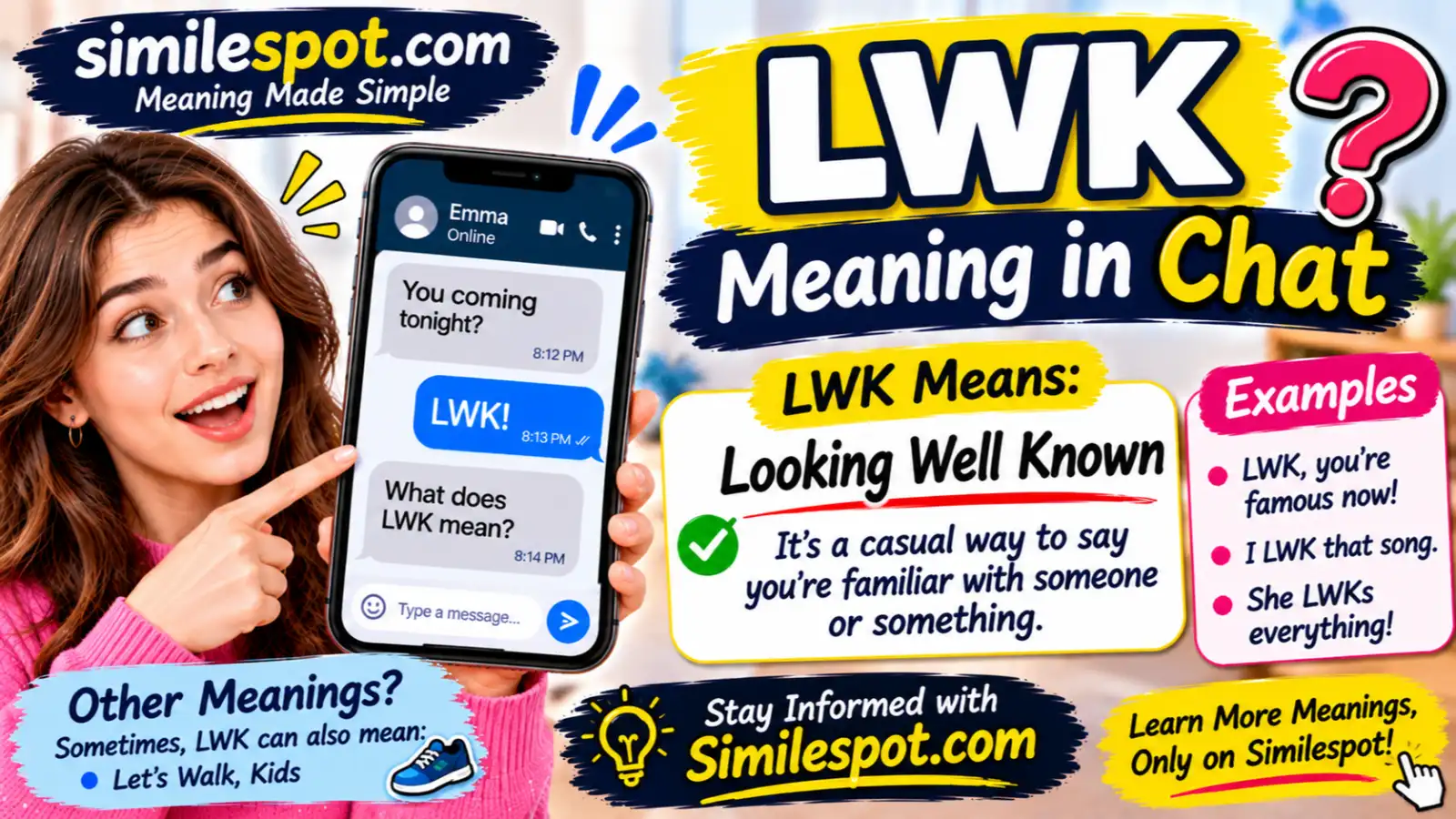
Have you ever received a message containing LWK and wondered what the person was trying to say? 🤔 Online conversations move quickly, and people often use short expressions instead of typing complete sentences. If you are unfamiliar with texting slang, even three simple letters can leave you confused.
The LWK meaning in chat is commonly “low-key.” People use this abbreviation to express something quietly, subtly, privately, or without making a big deal about it. It can also soften an opinion or describe a feeling that someone does not want to emphasize too strongly.
For example, someone might text, “I LWK like that song.” This means they secretly or somewhat like the song, even if they are not making a big announcement about it.
You may see LWK in private messages, social media comments, group chats, and casual conversations. Understanding it can help you follow online discussions and respond naturally.
In this guide, you will discover what LWK means, how people use it, where it came from, how it changes the tone of a sentence, and how it differs from similar slang expressions. Let’s get started! 💬
1. What Does LWK Mean in Chat? 📱
The most common LWK meaning in chat is “low-key.” It is an informal abbreviation used to describe something subtle, private, understated, or not strongly expressed.
People often use LWK when they want to share an opinion or feeling without making it sound too serious or dramatic.
For example:
Friend A: Do you like that new song?
Friend B: Yeah, I LWK love it.
Here, LWK means the person likes the song but is expressing that feeling casually.
Simple Definition of LWK
LWK is a shortened form of “low-key.” In texting and online conversations, it can mean secretly, somewhat, quietly, or without drawing much attention to something.
Here are some common ways people use it:
- Secretly: Sharing a feeling that someone may not openly discuss.
- Somewhat: Expressing a moderate opinion or emotion.
- Quietly: Describing something without attracting attention.
- Subtly: Showing a preference or reaction in an understated way.
- Casually: Making a statement without sounding overly excited or serious.
The exact meaning depends on the sentence.
For instance, “I LWK miss summer” expresses a feeling in a casual way. Meanwhile, “Let’s keep it LWK” suggests keeping something quiet or understated.
Is LWK the Same as Low-Key?
Yes. LWK is simply a shortened written form of low-key.
The full phrase is more common in standard writing, while LWK is mainly used in informal digital conversations.
2. What Does LWK Stand For? 🔍
LWK generally stands for low-key in casual texting.
The expression has a longer history in English than its abbreviated form. People use “low-key” to describe something that is restrained, understated, quiet, or not very noticeable.
Over time, online conversations encouraged shorter versions of familiar expressions. LWK became a convenient way to type the phrase without writing all its letters.
Understanding the Two Parts
The phrase “low-key” can communicate different ideas depending on the sentence.
- Low: Not high in level, intensity, or visibility.
- Key: In this expression, it is part of an established phrase rather than a separate texting instruction.
Together, “low-key” describes something understated or not strongly emphasized.
Common Interpretations of LWK
| Interpretation | What it communicates | Example |
|---|---|---|
| Secretly | A private feeling or thought | I LWK like him. |
| Somewhat | A moderate opinion | I’m LWK tired. |
| Quietly | Without attracting attention | Keep it LWK. |
| Subtly | An understated reaction | She LWK enjoyed it. |
| Honestly, but casually | A personal thought | I LWK agree. |
Important: LWK does not have to mean that someone is hiding a secret. In many messages, it simply softens the statement.
3. How Is LWK Used in Everyday Text Conversations? 💬
People use LWK in many types of casual conversations. It can describe feelings, preferences, reactions, plans, and personal opinions.
Here are some common situations where the abbreviation appears.
A. Expressing a Secret Feeling
Someone may use LWK when sharing a feeling they do not want to emphasize.
Example:
Alex: Do you enjoy spending time with the new group?
Jordan: Yeah, I LWK enjoy it.
Meaning: Jordan enjoys it but expresses the feeling casually.
B. Showing a Hidden Preference
LWK can describe a preference that someone has not openly discussed.
Example:
Friend: Which movie do you want to watch?
You: I LWK prefer the comedy.
Meaning: You somewhat prefer the comedy or have a quiet preference for it.
C. Softening an Opinion
Sometimes, people use LWK to make a statement sound less forceful.
Example:
Person A: What do you think about this design?
Person B: I LWK think the first one looks better.
Meaning: The person is sharing an opinion without making it sound too strong.
D. Describing a Feeling
LWK can also appear before an emotion or personal reaction.
Example:
Friend: Are you excited about the trip?
You: I’m LWK nervous.
Meaning: You feel somewhat nervous, even if you are not expressing it dramatically.
E. Keeping Something Understated
People may use LWK when they want an event or plan to remain casual.
Example:
Friend: Are you planning a big celebration?
You: No, let’s keep it LWK.
Meaning: The person wants a simple, low-key celebration rather than a large event.
4. What Does LWK Mean on Snapchat, Instagram, and TikTok? 📲
The basic meaning of LWK generally stays the same across social media platforms. People use it as a shortened version of “low-key” in posts, comments, captions, and private messages.
However, the sentence and platform can influence how the expression sounds.
LWK Meaning on Snapchat
Snapchat conversations are often casual and personal. Friends may use LWK when discussing their feelings, preferences, or daily experiences.
Example:
Friend: Did you enjoy the party?
You: Yeah, I LWK had fun.
The response means you enjoyed the party, although you are expressing it in an understated way.
You may also see messages such as:
- I LWK miss those days.
- I’m LWK excited.
- That was LWK funny.
- I LWK want to go again.
LWK Meaning on Instagram
Instagram users often include slang in comments, captions, and direct messages.
For example:
Person A: What do you think of this outfit?
Person B: I LWK love it!
The second person is expressing approval in a relaxed way.
LWK may also appear in comments such as:
- This picture is LWK amazing.
- I LWK needed this today.
- That song is LWK my favorite.
LWK Meaning on TikTok
TikTok has helped many informal expressions spread through videos, captions, comments, and trends.
Users may write LWK when describing reactions or opinions.
Example:
“I’m LWK obsessed with this trend.”
This means the person really likes the trend but is presenting the statement casually or playfully.
LWK Meaning on WhatsApp
WhatsApp users may use LWK in one-to-one conversations and group chats.
Example:
Friend: Do you want to join us tomorrow?
You: I LWK do, but I need to check my schedule.
Here, LWK softens the response and communicates interest without making a firm commitment.
Remember: LWK generally means “low-key” across these platforms. It does not need a different definition on every app.
5. Does LWK Mean Secretly, Somewhat, or Quietly? 🤫
One reason LWK can be confusing is that “low-key” has several related uses.
The abbreviation does not always communicate exactly the same feeling. It can describe a hidden preference, a moderate emotion, or an understated situation.
Understanding these differences makes it easier to interpret messages.
LWK as Secretly
When someone uses LWK to describe a private feeling, it can mean they have a preference or emotion they are not openly emphasizing.
Example:
“I LWK admire her work.”
This means the person admires her work but is expressing that opinion quietly or casually.
LWK as Somewhat
LWK can also reduce the intensity of an emotion or opinion.
Example:
“I’m LWK hungry.”
This means the person is somewhat hungry or feels a little hungry.
LWK as Quietly
In some sentences, LWK describes doing something without attracting attention.
Example:
“Let’s keep the celebration LWK.”
This means the celebration should remain simple and understated.
LWK as Subtly
It may also describe a reaction that is not obvious or strongly expressed.
Example:
“That comment was LWK funny.”
The speaker found the comment funny but is not making a big deal about it.
Quick Comparison
| Use of LWK | Meaning | Example |
|---|---|---|
| Secretly | A private feeling | I LWK like that idea. |
| Somewhat | A moderate feeling | I’m LWK worried. |
| Quietly | Without much attention | Keep the event LWK. |
| Subtly | Not strongly expressed | That was LWK impressive. |
The important thing is to read the complete sentence. The surrounding words usually reveal which interpretation makes the most sense.
6. Real-Life Examples of LWK in Text Messages ✨
Examples are one of the easiest ways to understand texting slang. The following conversations show how people might use LWK in different situations.
Example 1: Talking About Music
Alex: Have you listened to the new album?
Jordan: Yes, I LWK love it.
Meaning: Jordan likes the album but expresses the opinion casually.
Example 2: Discussing a Movie
Sam: Was the movie good?
Taylor: It was LWK amazing.
Meaning: Taylor enjoyed the movie and is emphasizing that opinion in a relaxed way.
Example 3: Sharing an Emotion
Riley: Are you nervous about tomorrow?
Morgan: I’m LWK nervous, not going to lie.
Meaning: Morgan feels somewhat nervous.
Example 4: Talking About Food
Chris: Do you want pizza or burgers?
Jamie: I LWK want pizza.
Meaning: Jamie has a preference for pizza but expresses it casually.
Example 5: Making Simple Plans
Friend A: Should we organize a huge party?
Friend B: Let’s keep it LWK.
Meaning: The second person prefers a simple, understated celebration.
Example 6: Discussing a Hobby
Person A: Do you enjoy drawing?
Person B: I LWK love it.
Meaning: The person has a strong interest but is expressing it in an informal way.
Example 7: Reacting to a Photograph
Friend A: What do you think of this picture?
Friend B: It’s LWK beautiful.
Meaning: The person thinks the picture is beautiful and gives a casual compliment.
Example 8: Talking About School
Student A: Are you excited about the school trip?
Student B: I’m LWK excited.
Meaning: The student feels some excitement but is not expressing it dramatically.
Example 9: Discussing a New Trend
Person A: Have you tried that new challenge?
Person B: I LWK want to try it.
Meaning: The person is interested but is keeping the statement casual.
Example 10: Sharing an Honest Opinion
Friend A: Do you think the first design is better?
Friend B: I LWK agree.
Meaning: The person agrees but uses a relaxed tone.
7. Where Did LWK Come From? Origin and Evolution of the Slang 🕰️
To understand LWK, it helps to look at the phrase “low-key” rather than treating the abbreviation as a completely separate expression.
Low-key has been used in English to describe something understated, restrained, quiet, or not very noticeable.
Over time, the phrase also became common in informal speech. People began using it to soften opinions and describe feelings without making them sound too strong.
As digital communication grew, users started shortening familiar expressions to make typing quicker.
LWK developed as an informal written version of low-key.
How the Expression Became Popular
Several changes in communication helped shortened expressions become common.
1. Text messaging
Mobile messaging encouraged people to write short responses and use fewer characters.
2. Online chat communities
Internet users developed casual language that made conversations feel faster and more relaxed.
3. Social media
Captions, comments, and direct messages created more opportunities for informal expressions to spread.
4. Short-form video culture
Videos and comments helped introduce slang to people who might not have encountered it elsewhere.
5. Everyday conversation
People began using online expressions in spoken conversations, making them part of everyday informal language.
Why Do People Prefer LWK?
There are several reasons:
- It is shorter than writing the full phrase.
- It gives messages a casual tone.
- It can soften an opinion.
- It works well in informal conversations.
- It can express feelings without sounding overly serious.
There is no need to assign LWK one exact invention date to understand its current use. Its meaning comes from the familiar expression “low-key.”
8. What Is the Difference Between LWK, Low-Key, High-Key, and NGL? 🆚
LWK is related to several other expressions used in casual digital communication. Knowing the differences can help you understand messages more accurately.
| Expression | Meaning | Common use |
|---|---|---|
| LWK | Low-key | Expressing something subtly |
| Low-key | Understated or somewhat | Describing a quiet feeling |
| High-key | Strongly or openly | Emphasizing a feeling |
| NGL | Not Gonna Lie | Introducing an honest opinion |
| TBH | To Be Honest | Giving a personal opinion |
| FR | For Real | Showing agreement or emphasis |
| IMO | In My Opinion | Sharing a viewpoint |
| Kinda | Somewhat or rather | Softening a statement |
LWK vs. Low-Key
These expressions generally communicate the same idea.
The main difference is how they are written.
Example:
- I low-key like this song.
- I LWK like this song.
Both express a casual or understated preference.
LWK vs. High-Key
High-key is often used as the opposite of low-key.
While LWK suggests something subtle or understated, high-key emphasizes something strongly or openly.
Example:
- I LWK love this movie.
- I high-key love this movie.
The first sounds more understated. The second communicates stronger enthusiasm.
LWK vs. NGL
NGL means “not gonna lie.” People use it when introducing an honest opinion or reaction.
Example:
“I LWK like this design, NGL.”
Here, LWK softens the preference, while NGL emphasizes honesty.
LWK vs. TBH
TBH means “to be honest.” It introduces an opinion or personal thought.
Example:
“TBH, I LWK prefer the first option.”
The speaker is honestly sharing a preference while keeping the tone relaxed.
LWK vs. Kinda
Kinda means “kind of” and is often used to soften a statement.
Example:
“I’m kinda tired.”
This is similar to:
“I’m LWK tired.”
However, the expressions are not interchangeable in every sentence. Low-key can also describe something private or understated, while kinda usually expresses degree.
9. Does LWK Sound Rude, Flirty, or Friendly? 😊
LWK is not automatically rude, romantic, or friendly. Its tone depends on the message, the relationship between the people, and the situation.
The same abbreviation can communicate different feelings in different conversations.
Friendly Tone
LWK can sound friendly when someone uses it to share a positive opinion.
Example:
Friend: Did you enjoy the concert?
You: I LWK had the best time!
The message sounds casual and positive.
Playful Tone
People may use LWK when making jokes or playful comments.
Example:
Person A: You really like that show, don’t you?
Person B: I LWK watch it every day.
The response sounds humorous and relaxed.
Shy or Understated Tone
Someone may use LWK when they want to express a feeling without making it sound too direct.
Example:
“I LWK admire your creativity.”
The speaker is sharing a compliment in a subtle way.
Neutral Tone
LWK can simply soften an ordinary statement.
Example:
“I’m LWK tired today.”
This communicates a feeling without suggesting any particular attitude toward another person.
Can LWK Sound Flirty?
It can appear in a playful or affectionate conversation, but the abbreviation itself is not necessarily romantic.
For example:
“I LWK enjoy talking to you.”
This expresses a positive feeling. Whether it sounds flirty depends on the wider conversation and the relationship between the people.
Helpful reminder: Do not judge someone’s intentions based on one abbreviation. Read the complete message and consider the context.
10. How Should You Respond When Someone Texts LWK? 💡
If someone sends you LWK, the best response depends on the sentence.
Since LWK usually means low-key, you can respond naturally without repeating the abbreviation every time.
Here are some useful examples.
If Someone Shares a Preference
Friend: I LWK prefer the blue one.
You can reply:
- Same, I like that one too.
- I think it looks better.
- Fair enough!
- That’s a good choice.
If Someone Shares a Feeling
Friend: I’m LWK nervous about tomorrow.
You can reply:
- I understand.
- I hope everything goes well.
- You’ll be fine.
- What’s making you nervous?
If Someone Gives a Compliment
Friend: Your new design is LWK amazing.
You can reply:
- Thank you!
- Glad you like it.
- I appreciate that.
- Thanks, I worked hard on it.
If Someone Suggests Keeping Things Simple
Friend: Let’s keep the plan LWK.
You can reply:
- Sounds good.
- Simple works for me.
- That’s a great idea.
- Let’s do that.
If You Do Not Understand the Abbreviation
You can ask:
- What does LWK mean?
- Do you mean low-key?
- Can you explain that expression?
- Is that another way of saying low-key?
A simple question can prevent confusion and keep the conversation comfortable.
11. When Should You Use LWK? Formal vs. Informal Communication 📝
LWK is mainly an informal abbreviation. It works best in relaxed conversations where the other person understands texting slang.
However, it may not be suitable for every situation.
Appropriate Situations
You can use LWK when chatting with:
- Friends
- Classmates
- Siblings and relatives
- Familiar group-chat members
- People who regularly use internet slang
- Social media followers in casual discussions
Situations Where You Should Avoid It
Consider writing the complete phrase in:
- Formal emails
- School assignments
- Professional messages
- Official requests
- Business communication
- Messages to people unfamiliar with internet slang
Better Alternatives for Formal Writing
| Informal expression | More formal alternative |
|---|---|
| I LWK agree. | I somewhat agree. |
| I’m LWK worried. | I am slightly concerned. |
| Let’s keep it LWK. | Let’s keep it simple and understated. |
| I LWK prefer this. | I slightly prefer this option. |
| I LWK enjoyed it. | I enjoyed it more than I expected. |
Example of Professional Writing
Instead of writing:
“I LWK think the first design is better.”
You could write:
“I believe the first design is slightly more suitable.”
The second sentence is clearer and more appropriate for professional communication.
Tip: Use LWK when the conversation is casual. Choose the complete phrase when clarity and formality matter.
12. Common Mistakes People Make When Using LWK ⚠️
Although LWK is easy to understand once you know its meaning, people sometimes use it incorrectly or misunderstand its tone.
Here are some common mistakes to avoid.
Mistake 1: Thinking LWK Always Means Secretly
LWK can mean secretly in some situations, but it can also mean somewhat, quietly, or subtly.
For example:
- “I LWK like this song” expresses an understated preference.
- “Let’s keep it LWK” describes a simple or low-profile plan.
The sentence determines the meaning.
Mistake 2: Confusing LWK With High-Key
These expressions usually communicate opposite levels of emphasis.
LWK suggests something understated, while high-key suggests something strong or obvious.
Mistake 3: Assuming LWK Is Always Romantic
LWK is not a romantic abbreviation by itself.
People use it when discussing music, food, school, hobbies, feelings, plans, and many other everyday topics.
Mistake 4: Using It in Formal Writing
LWK may confuse readers who do not understand internet slang.
In professional or academic writing, use “low-key” or another complete expression.
Mistake 5: Ignoring the Sentence
Do not interpret LWK without considering the surrounding words.
For example, “I’m LWK excited” and “Keep the party LWK” use the expression differently.
Mistake 6: Overusing the Abbreviation
Using the same slang expression in every sentence can make writing repetitive.
Mix informal expressions with complete phrases to keep conversations natural.
FAQs:
1. What does LWK mean in chat?
LWK commonly stands for low-key. It is used to express something subtly, secretly, somewhat, or without making a big deal about it. Its exact meaning depends on the sentence.
2. What does LWK mean from a girl or boy?
The abbreviation has the same basic meaning regardless of who sends it. It generally means low-key. The sender may be expressing a quiet preference, a subtle feeling, or a casual opinion.
3. Is LWK the same as low-key?
Yes. LWK is an informal shortened form of low-key. People use it in digital conversations to save typing time and create a casual tone.
4. What does LWK mean on Snapchat?
On Snapchat, LWK generally means low-key. Someone might write “I LWK miss those days” to express a feeling in an understated way.
5. Is LWK positive or negative?
LWK is neither automatically positive nor negative. It depends on the words around it. Someone can use it to describe a positive preference, a mild concern, or a simple plan.
Final Thoughts:
Understanding the LWK meaning in chat makes online conversations easier to follow. In most casual messages, LWK stands for low-key. People use it to express something quietly, subtly, somewhat, or without drawing too much attention.
You may see it on Snapchat, Instagram, TikTok, WhatsApp, and other messaging platforms. It can describe feelings, preferences, opinions, and everyday situations.
Here are the main points to remember:
- LWK commonly means low-key.
- It can express a private or understated feeling.
- It may also mean somewhat or subtly.
- Its meaning depends on the sentence and conversation.
- It is mainly used in informal digital communication.
- High-key is often used as its opposite.
- Complete words are better for formal writing.
💬 Want to learn more about texting slang and popular internet abbreviations? Explore related posts on our website to discover the meanings of everyday expressions and understand how people use them in online conversations.
I am a passionate writer at SimileSpot who loves playing with words. I create clear and creative similes to make ideas easy to understand and fun to read.