
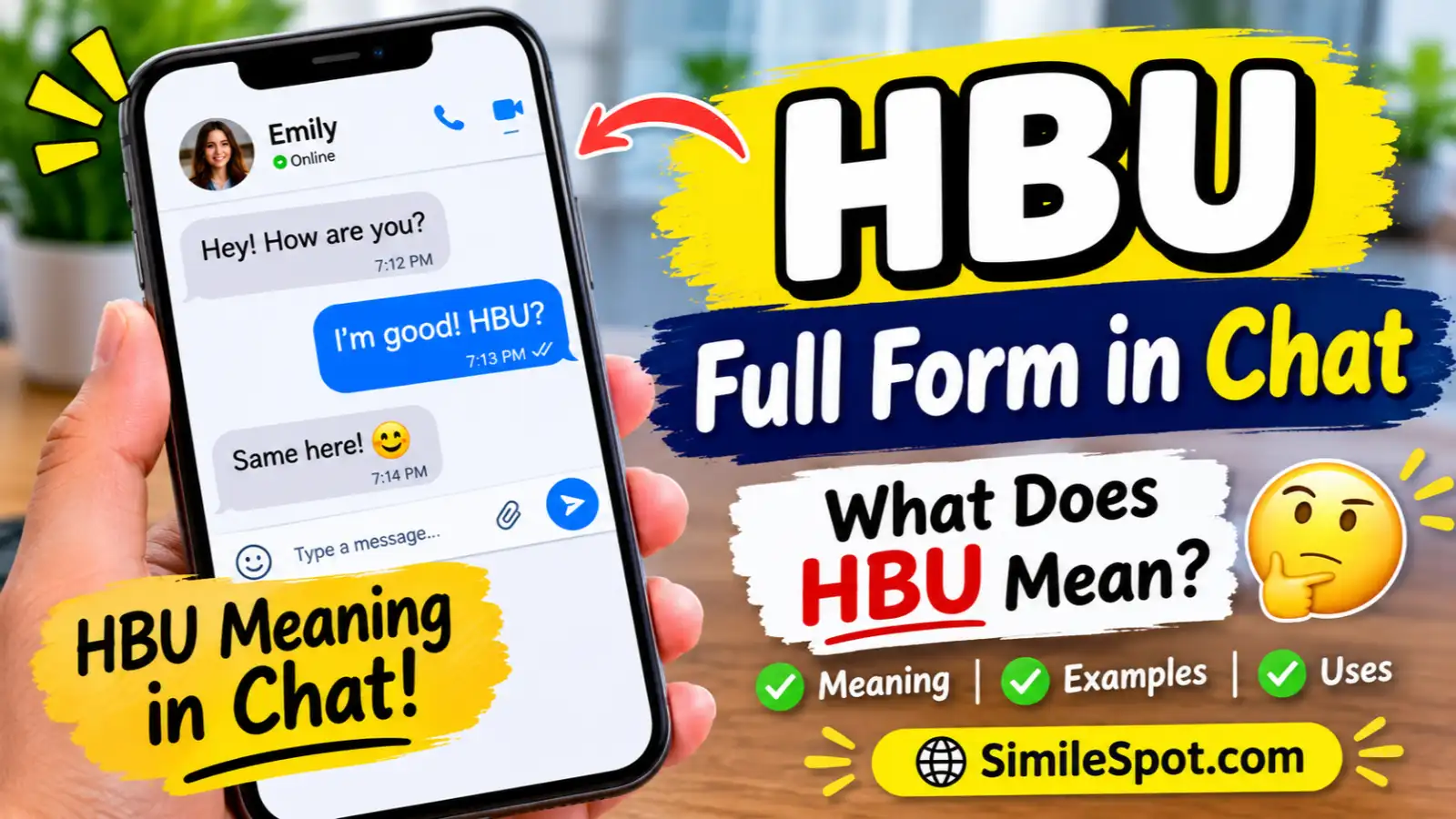
Have you ever received a message that simply says HBU? and wondered what the other person was asking? You are not alone! Texting has changed the way people communicate. Short abbreviations, internet slang, and quick expressions have become part of everyday conversations. Among these popular shortcuts, HBU full form in chat is something you will frequently see on messaging apps and social media platforms.
HBU stands for How About You? People use it to ask another person the same question that was just asked of them. It helps keep conversations moving without typing a complete sentence.
For example, imagine that your friend asks, “How are you today?” You reply, “I’m doing great, HBU?” Instead of writing “How about you?”, you simply use three letters. The message stays friendly, natural, and easy to understand.
But there is more to this abbreviation than its basic meaning. HBU can appear in different conversations, including casual chats, friendships, online discussions, and even some workplace messages. Understanding its tone and context can help you respond confidently.
In this guide, we will explore the HBU full form in chat, its meaning, origin, practical examples, alternative expressions, and appropriate replies. Let’s get started! 😊
1. What Is the HBU Full Form in Chat? 🤔
The most common full form of HBU is How About You?
It is a popular texting abbreviation used in digital conversations. People generally use it when they want to ask someone about their opinion, feelings, activities, preferences, or experiences.
Instead of typing the complete phrase, they write HBU to save time and keep their messages short.
For example:
Person A: Hey! How was your weekend?
Person B: It was amazing! HBU?
Here, Person B is asking Person A about their weekend.
The abbreviation is especially useful when two people are exchanging information. It makes conversations feel more natural because both participants get an opportunity to share something.
Quick Meaning of HBU
| Detail | Explanation |
|---|---|
| Abbreviation | HBU |
| Full Form | How About You? |
| Category | Internet slang |
| Main Purpose | Asking about another person |
| Tone | Friendly and casual |
| Common Usage | Text messages and online chats |
| Capitalization | HBU or hbu |
In simple words: HBU means “How About You?” It is a quick way to return a question to someone during a conversation.
You might see it after questions about someone’s day, mood, interests, plans, or personal preferences.
2. What Does HBU Mean in Texting and Social Media? 📱
The HBU meaning in text remains the same across most digital communication platforms. It stands for “How About You?”
However, its purpose can change slightly depending on the conversation.
People use HBU to show interest, continue discussions, and encourage others to share their thoughts.
Let’s understand its common uses.
A. Asking About Someone’s Feelings
One of the most common uses of HBU is asking someone how they feel.
Example:
Friend: I’m feeling really happy today!
You: That’s great! HBU?
In this conversation, HBU invites the other person to share their feelings.
B. Asking About Daily Activities
People also use HBU when discussing their everyday routines.
Example:
Person A: I’m watching my favorite movie.
Person B: Nice! HBU after dinner?
Here, the abbreviation helps continue a casual discussion about activities.
C. Asking About Opinions
HBU can also be used when someone wants to know another person’s opinion.
Example:
Friend: I think this new game is interesting. HBU?
You: I like it too!
This makes the conversation more interactive.
D. Asking About Future Plans
Another common use is discussing upcoming activities.
Example:
Person A: I’m planning to visit my cousins tomorrow.
Person B: Sounds fun! HBU?
The second person is inviting the first person to share their plans.
E. Keeping Conversations Alive
Sometimes, people use HBU simply because they do not want a conversation to end.
For instance:
Person A: I’m listening to music.
Person B: Cool! HBU?
This small abbreviation gives the other person an opportunity to continue talking.
3. Origin and History of HBU 📖
Like many internet abbreviations, HBU developed as part of the growing trend toward shorter digital communication.
Before smartphones became common, people frequently used SMS messaging to communicate. Traditional text messages often had character limits, and typing on older mobile phone keyboards could take considerable time.
As a result, users started shortening everyday phrases.
Expressions such as LOL, BRB, BTW, IDK, and HBU became familiar parts of online communication.
HBU emerged as a convenient abbreviation for “How About You?”
It follows a simple pattern: taking the first letters of the words in a common phrase.
- H = How
- B = About
- U = You
Over time, this abbreviation became familiar among people using online messaging services, social networking platforms, and mobile chat applications.
How HBU Became Popular
Several factors helped make HBU a recognizable texting expression:
1. Faster Communication
People wanted to exchange messages quickly. Short abbreviations made everyday conversations easier.
2. Mobile Messaging
The increasing popularity of mobile phones encouraged users to adopt shorter expressions.
3. Social Media Culture
Online conversations introduced new ways of communicating. Abbreviations became a normal part of digital language.
4. Casual Conversations
HBU sounds informal and friendly. It fits naturally into conversations between friends and acquaintances.
Today, people continue using HBU because it is short, recognizable, and easy to understand.
4. How to Use HBU in Different Conversations 💬
Understanding the HBU full form in chat is only the first step. Knowing when and how to use it makes communication easier.
Although HBU is commonly associated with casual conversations, it can fit several situations.
Here are some practical examples.
A. When Talking to Friends
Friends frequently use HBU when discussing their daily experiences.
Example:
You: Hey! I’m having a great day. HBU?
Friend: Mine is going pretty well too!
This is a simple way to exchange updates.
B. When Meeting Someone New
HBU can help maintain a conversation when getting to know someone.
Example:
Person A: What kind of movies do you enjoy?
Person B: I love comedy movies. HBU?
Person A: I’m more into action movies.
It encourages both people to participate.
C. When Discussing School or Studies
Students can use HBU when talking about their academic experiences with classmates.
Example:
Student A: I found today’s science lesson interesting. HBU?
Student B: Same! The experiments were my favorite part.
D. When Discussing Weekend Plans
HBU is also useful when talking about free-time activities.
Example:
Person A: I’m going shopping this Saturday. HBU?
Person B: I’m planning to spend time with my family.
E. When Chatting Online
People often use HBU during social media conversations.
Example:
You: I really enjoyed that video!
Friend: Same here! HBU?
Depending on the context, the other person might be asking about your favorite part or overall experience.
F. When Talking About Hobbies
HBU makes it easier to exchange information about personal interests.
Example:
Person A: I enjoy playing football in my free time. HBU?
Person B: I prefer reading books.
The abbreviation helps make the exchange feel natural.
5. Best Examples of HBU in Text Messages ✨
The easiest way to understand an abbreviation is to see how people use it in real conversations.
Below are original example conversations showing different ways to use HBU.
| Situation | Example Message | Meaning |
|---|---|---|
| Daily routine | I’m going for a walk. HBU? | Asking about your activity |
| Mood | I’m feeling great today! HBU? | Asking how you feel |
| Weekend | My weekend was awesome. HBU? | Asking about your weekend |
| Food | I love pizza. HBU? | Asking about your preference |
| Music | I’m listening to pop music. HBU? | Asking what you listen to |
| Movies | I enjoy comedy films. HBU? | Asking about movie preferences |
| School | I finished my homework. HBU? | Asking about your progress |
| Weather | I love rainy days. HBU? | Asking about your opinion |
| Travel | I want to visit Japan. HBU? | Asking about travel interests |
| Sports | I enjoy basketball. HBU? | Asking about your favorite sport |
More Short HBU Conversations
Example 1: Talking About Your Day
A: Hey, how’s your day going?
B: Pretty good! HBU?
A: Mine is going well too.
Example 2: Discussing Music
A: I love listening to relaxing music.
B: Same! HBU?
A: I usually listen to pop songs.
Example 3: Talking About Food
A: My favorite food is pasta.
B: Nice! HBU?
A: I prefer burgers.
Example 4: Discussing Free Time
A: I usually read books after school.
B: That’s interesting! HBU?
A: I enjoy playing outdoor games.
Example 5: Talking About Movies
A: I watched a comedy movie yesterday.
B: Was it good?
A: Yes, I loved it. HBU?
These examples show how HBU can make conversations shorter without changing their meaning.
6. How to Reply to HBU in a Text Message? 💡
If someone sends you HBU, there is no need to feel confused. The best response depends on the question they are returning to you.
Usually, you should answer the original question or share your own experience.
Here are several useful replies.
A. Simple and Friendly Replies
These responses work well in everyday conversations.
- I’m doing great!
- Pretty good, thanks!
- I’m fine too.
- Everything is going well.
- Not bad at all.
- I’m having a good day.
- Doing well, thanks for asking!
B. Casual Replies to Friends
When chatting with friends, you can use relaxed expressions.
- Just chilling!
- Same as always.
- Having a relaxing day.
- Nothing special, just hanging out.
- Doing pretty well!
- Just enjoying my free time.
- All good here!
C. Funny Replies
If the conversation is playful, you can use a little humor.
- Surviving Monday!
- Better now that I have snacks!
- Just being awesome!
- Waiting for the weekend!
- Living my best life!
- Powered by coffee!
- Still figuring things out!
D. Replies When You Are Busy
Sometimes, you might not have enough time for a long conversation.
In that situation, short responses work perfectly.
- A little busy right now.
- Just finishing some work.
- Having a packed day.
- I’ll tell you more later.
- Taking care of a few things.
- Pretty busy, but everything is fine.
E. Replies When You Want to Continue the Conversation
If you want to keep chatting, answer and ask another question.
For example:
Friend: I’m going to the cinema tonight. HBU?
You: I’m staying home tonight. Which movie are you watching?
This approach helps conversations develop naturally.
Quick Reply Guide
| Their Message | Possible Reply |
|---|---|
| I’m good, HBU? | I’m doing great too! |
| I love football, HBU? | I enjoy basketball. |
| I’m watching a movie, HBU? | I’m listening to music. |
| I had a busy day, HBU? | Mine was pretty relaxed. |
| I’m going out tonight, HBU? | I’m staying home today. |
Helpful tip: Always consider the original question before replying to HBU. This helps you provide a relevant answer rather than sending something unrelated.
7. Difference Between HBU, WBU, and WYD 🔍
People sometimes confuse HBU with other texting abbreviations because they are commonly used in similar conversations.
Three expressions worth understanding are HBU, WBU, and WYD.
Although they look different, each has its own purpose.
HBU – How About You?
HBU is used to return a question to another person.
Example:
Friend: I enjoy playing video games. HBU?
You: I prefer watching movies.
WBU – What About You?
WBU stands for “What About You?”
It is very similar to HBU. Both expressions invite another person to share their thoughts, preferences, or experiences.
Example:
Person A: I love traveling.
Person B: WBU?
WYD – What Are You Doing?
WYD stands for “What You Doing?” or “What Are You Doing?” in informal texting.
People use it to ask about someone’s current activity.
Example:
Friend: WYD?
You: Just watching television.
Comparison Table
| Abbreviation | Full Form | Main Purpose |
|---|---|---|
| HBU | How About You? | Returning a question |
| WBU | What About You? | Asking for another person’s opinion |
| WYD | What Are You Doing? | Asking about current activities |
| HRU | How Are You? | Asking about someone’s condition |
| WYD RN | What Are You Doing Right Now? | Asking about present activities |
Are HBU and WBU Interchangeable?
In many everyday conversations, yes.
Both HBU and WBU can be used to ask another person about themselves.
For example:
- I love reading novels. HBU?
- I love reading novels. WBU?
Both messages communicate nearly the same idea.
However, the best choice depends on your personal texting style and the flow of the conversation.
8. Is HBU Formal or Informal? 🎯
HBU is generally an informal texting abbreviation.
It works best in relaxed conversations where people already understand internet slang.
You can comfortably use it with friends, classmates, relatives, and people you know well.
However, it may not be the best choice in formal communication.
When Is HBU Appropriate?
Consider using HBU in these situations:
- Casual conversations with friends.
- Personal messages.
- Social media discussions.
- Conversations with classmates.
- Informal group chats.
- Friendly conversations with acquaintances.
When Should You Avoid HBU?
There are situations where writing the complete phrase is a better option.
For example:
Professional Emails
Instead of writing:
“Thank you for the update. HBU?”
Write:
“Thank you for the update. How about you?”
Formal Business Conversations
Professional communication usually benefits from complete sentences.
Academic Communication
When writing to teachers or communicating in formal academic settings, avoid unnecessary texting shortcuts.
Formal and Informal Alternatives
| Informal Expression | More Formal Alternative |
|---|---|
| HBU? | How about you? |
| WBU? | What about you? |
| HRU? | How are you doing? |
| WYD? | What are you currently doing? |
| LMK | Please let me know. |
Remember: HBU is not rude or disrespectful. It is simply casual language. Choosing the right expression for your audience makes communication more effective.
9. Common Mistakes People Make When Using HBU ⚠️
Although HBU is easy to understand, people sometimes use it incorrectly.
Understanding these mistakes can help you communicate more clearly.
Mistake 1: Using HBU Without Context
HBU usually works best when there is an existing question or topic.
For example:
“What’s your favorite sport? HBU?”
This is understandable if the speaker is returning the question after sharing their own preference.
However, sending HBU without any context may leave the other person wondering what you are asking.
Mistake 2: Confusing HBU With WYD
These abbreviations do not have the same meaning.
- HBU means How About You?
- WYD means What Are You Doing?
Using one instead of the other can change the meaning of your message.
Mistake 3: Using HBU in Every Sentence
Although abbreviations save time, repeating them too often can make conversations feel unnatural.
Try using complete sentences when the conversation requires more explanation.
Mistake 4: Assuming HBU Always Refers to Feelings
HBU is not limited to asking how someone feels.
It can also refer to opinions, activities, preferences, plans, and experiences.
Always consider the surrounding conversation.
Mistake 5: Using It in Every Professional Message
HBU is casual internet language.
When communicating with clients, teachers, or professional contacts, writing “How about you?” is often more appropriate.
Mistake 6: Thinking Capitalization Changes the Meaning
HBU, hbu, and Hbu generally communicate the same thing.
The capitalization does not usually change the abbreviation’s meaning.
10. Other Popular Texting Abbreviations Related to HBU 🌐
HBU is only one example of the many shortcuts people use in digital communication.
Learning other common abbreviations can help you understand messages more easily.
Here are some expressions you might encounter.
| Abbreviation | Full Form | Meaning |
|---|---|---|
| LOL | Laughing Out Loud | Expressing amusement |
| BRB | Be Right Back | Temporarily leaving |
| BTW | By The Way | Introducing additional information |
| IDK | I Don’t Know | Expressing uncertainty |
| IMO | In My Opinion | Sharing a personal view |
| TBH | To Be Honest | Expressing honesty |
| FYI | For Your Information | Sharing useful information |
| NVM | Never Mind | Asking someone to disregard something |
| TTYL | Talk To You Later | Ending a conversation temporarily |
| LMK | Let Me Know | Requesting an update |
| OMG | Oh My God | Expressing surprise |
| RN | Right Now | Referring to the present moment |
| HMU | Hit Me Up | Asking someone to contact you |
| WBU | What About You? | Returning a question |
| WYD | What Are You Doing? | Asking about someone’s activity |
| HRU | How Are You? | Asking about someone’s condition |
Why Should You Learn These Abbreviations?
Understanding common texting expressions offers several advantages.
1. Better Communication: You can understand messages without repeatedly asking what they mean.
2. Faster Responses: You can reply naturally during casual conversations.
3. Improved Digital Confidence: Familiarity with online language makes social media communication easier.
4. Fewer Misunderstandings: Knowing the meaning of abbreviations helps you understand the speaker’s intention.
However, remember that not every abbreviation is appropriate for every situation. Context always matters.
11. FAQs About HBU Full Form in Chat ❓
Here are answers to some frequently asked questions about HBU and its use in texting.
1. What Is the HBU Full Form in Chat?
HBU stands for How About You? It is a common texting abbreviation used to ask another person about their feelings, opinions, experiences, or activities.
For example, “I’m doing great, HBU?” means “I’m doing great, how about you?”
2. What Does HBU Mean From a Girl or Boy?
HBU has the same basic meaning regardless of who sends it. It stands for “How About You?”
A girl or boy might use it to continue a conversation, ask about your experience, or show interest in your opinion. Its meaning depends on the surrounding conversation rather than the sender’s gender.
3. How Should I Reply When Someone Says HBU?
You should answer the question or topic they are referring to.
For example:
Person: I’m having a wonderful day. HBU?
You: Mine is going pretty well too!
You can also ask another question to keep the conversation going.
4. Is HBU the Same as WBU?
HBU and WBU have very similar meanings.
- HBU means How About You?
- WBU means What About You?
Both expressions are commonly used to return a question or invite someone to share their thoughts.
5. Can I Use HBU in Professional Messages?
HBU is generally informal. It is better to write the complete phrase “How about you?” in professional emails, formal conversations, and academic communication.
This makes your message clearer and more appropriate for the situation.
Conclusion: Final Thoughts 💬
Understanding the HBU full form in chat makes everyday digital communication easier. HBU stands for How About You? It is a popular abbreviation that helps people exchange opinions, discuss activities, share experiences, and keep conversations moving.
Whether you are chatting with friends, talking to classmates, or participating in an online discussion, HBU offers a quick and friendly way to return a question.
Here are the most important points to remember:
- HBU means How About You?
- It is commonly used in texting and social media conversations.
- It helps people ask about another person’s thoughts, feelings, and experiences.
- HBU and WBU have very similar meanings.
- It is best suited to informal communication.
- You can reply by answering the original question or sharing your own experience.
The next time someone sends you HBU, you will know exactly what they mean and how to respond!
Want to understand more internet slang and texting expressions? Explore more helpful guides on SimileSpot to discover the meanings of popular abbreviations, improve your digital communication, and stay updated with modern online language. 😊

I am a passionate writer at SimileSpot who loves playing with words. I create clear and creative similes to make ideas easy to understand and fun to read.