
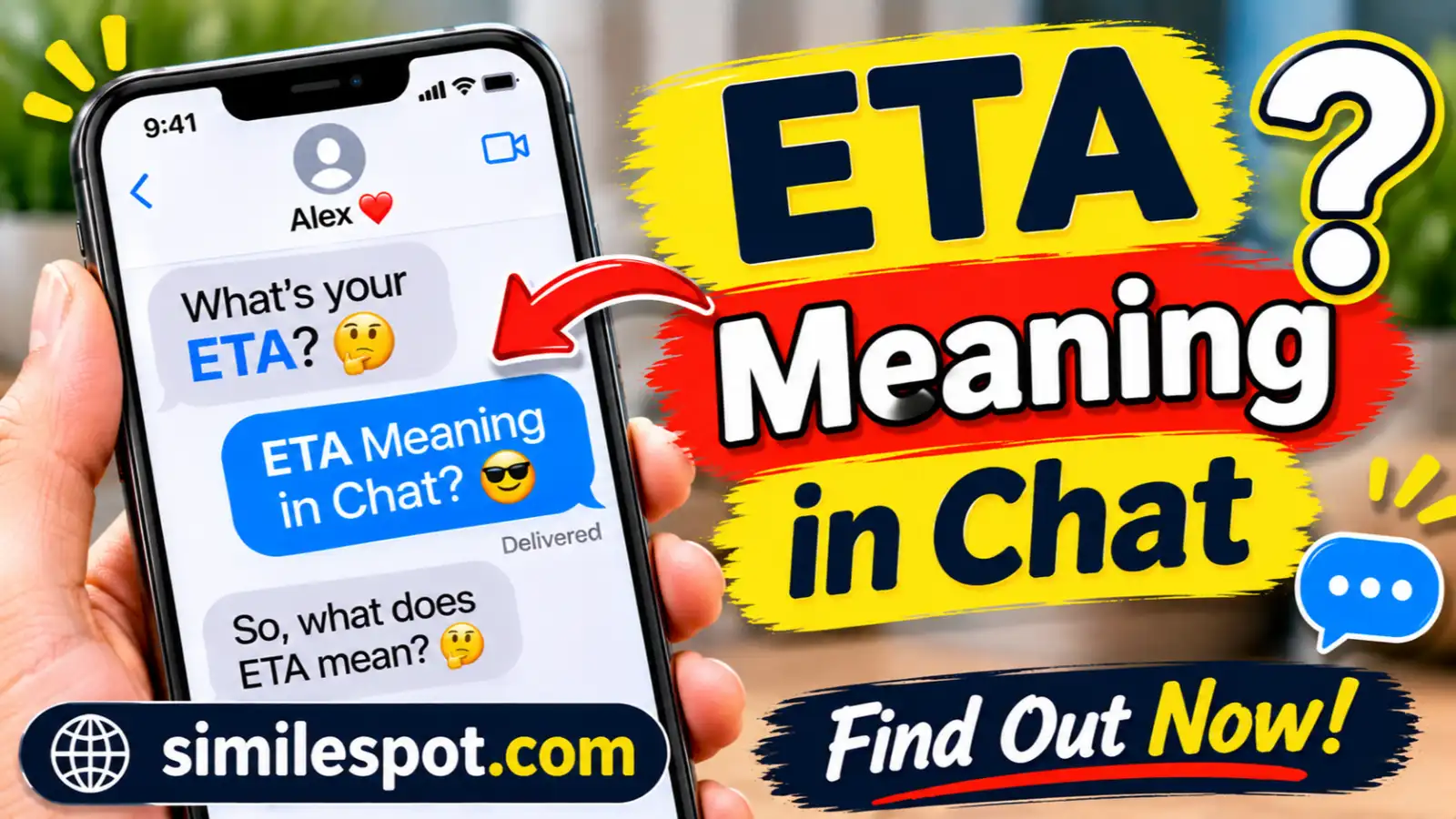
Have you ever received a message that simply says, “ETA?” and wondered what the other person wanted to know? You might see it in a conversation with friends, family, coworkers, or even someone waiting for you at a restaurant. Although it looks like internet slang, this abbreviation has a practical meaning that makes everyday communication easier.
The ETA meaning in chat is Estimated Time of Arrival. People use it to ask when someone will reach a particular place or when something is expected to arrive. Instead of typing a complete question like “What time do you think you will get here?”, someone can simply send “ETA?”
For example:
- Friend: “We are waiting outside. ETA?”
- You: “Around 15 minutes!”
This short exchange communicates everything both people need to know.
However, ETA is not limited to meeting friends. People also use it when discussing food deliveries, online orders, transportation, appointments, work tasks, and project deadlines.
In this guide, you will learn what ETA means in chat, where it comes from, how people use it, and how to respond naturally when someone sends it to you. Let’s explore this useful abbreviation! 💬
1. What Does ETA Mean in Chat?
ETA stands for Estimated Time of Arrival. It tells someone when a person, vehicle, package, or other expected arrival is likely to reach its destination.
In everyday texting, people usually use ETA as a quick way to ask about arrival time.
For example, imagine your friend is traveling to meet you. You have already reached the meeting place, but your friend has not arrived. Instead of sending a long message, you can simply write:
“What’s your ETA?”
Your friend might respond:
“My ETA is 20 minutes.”
This means they expect to arrive in approximately 20 minutes.
Simple Definition of ETA
| Term | Meaning |
|---|---|
| ETA | Estimated Time of Arrival |
| Main purpose | Asking or sharing an expected arrival time |
| Common use | Texting, travel, deliveries, and work |
| Communication style | Short, practical, and informal |
| Example | “ETA is 10 minutes.” |
The word estimated is important. It means the time is an approximation, not a guaranteed arrival time.
For instance, if someone says their ETA is 5:30 PM, they expect to arrive around that time. Traffic, weather, delays, or unexpected problems might change their plans.
Is ETA Slang?
Not exactly. ETA is an abbreviation, not traditional internet slang.
It originated as a practical term for estimating arrival times. However, texting and social media have made it a familiar part of everyday digital conversations.
People often treat it like casual slang because they use it in short messages.
Quick takeaway: When someone sends you “ETA?” in a chat, they are usually asking, “When will you arrive?”
2. What Is the Full Form of ETA?
The full form of ETA is Estimated Time of Arrival.
Each word explains a different part of the abbreviation:
- E – Estimated: A predicted or approximate time.
- T – Time: The specific time or duration.
- A – Arrival: Reaching a destination or expected location.
Together, these words describe the predicted time when someone or something should arrive.
Understanding the Full Form With an Example
Suppose your cousin is traveling to your house. You want to know when they will arrive.
You send:
“Hey, what’s your ETA?”
Your cousin replies:
“ETA is 7:15 PM.”
This tells you that your cousin expects to reach your house at approximately 7:15 PM.
The abbreviation saves time and makes the conversation easier.
Why Do People Use ETA Instead of the Full Phrase?
There are several reasons:
- It saves time: Three letters are easier to type than the complete phrase.
- It is widely understood: Many people recognize ETA without needing an explanation.
- It sounds natural: The abbreviation fits casual and professional conversations.
- It provides clear information: People immediately understand that the discussion concerns arrival time.
ETA is particularly useful when someone needs a quick update.
For example, a delivery driver can message a customer, “ETA 10 minutes,” instead of writing a longer explanation.
3. Origin and History of ETA
Although many people associate ETA with modern texting, the abbreviation existed long before smartphones and social media became popular.
ETA developed as a practical term in transportation, navigation, aviation, shipping, and logistics. These industries needed a convenient way to communicate when a person, vehicle, or shipment was expected to reach its destination.
ETA in Transportation
Travelers and transportation professionals often need accurate arrival estimates.
For example:
- A pilot may receive an estimated arrival time for an aircraft.
- A ship’s crew may communicate when a vessel should reach a port.
- A train operator may provide passengers with an expected arrival time.
- A driver may tell someone when they expect to reach a destination.
In these situations, ETA helps people plan their activities.
How Did ETA Become Popular in Texting?
As mobile phones and digital messaging became common, people started using familiar professional abbreviations in everyday conversations.
ETA was especially convenient because it communicated a complete question in just three letters.
Instead of typing:
“Can you tell me approximately when you will arrive?”
Someone could simply write:
“ETA?”
The abbreviation gradually became common in personal messages, group chats, workplace conversations, and online communities.
ETA in Modern Digital Communication
Today, people use ETA in many different situations:
- Asking friends when they will arrive.
- Checking when food delivery will reach their home.
- Getting updates about online purchases.
- Discussing travel schedules.
- Following up on unfinished work.
- Asking when a particular task will be completed.
Its meaning has also expanded in some conversations. People sometimes use ETA informally to ask when something will be ready, even if the situation does not involve physical arrival.
4. How Is ETA Used in Text Messages?
The ETA meaning in chat becomes easier to understand when you look at real-life messaging situations.
People generally use ETA in two ways:
- To ask another person about their expected arrival.
- To tell someone when they expect to arrive.
Let’s explore both uses.
A. Asking Someone About Their Arrival
This is the most common use of ETA in texting.
Imagine your friend is supposed to meet you at a shopping mall. You have been waiting for a while.
You can send:
“Hey, ETA?”
Your friend understands that you want to know how much longer they need.
Other examples include:
- “What’s your ETA?”
- “Any update on your ETA?”
- “Do you know your ETA?”
- “ETA to the restaurant?”
- “What’s your estimated arrival time?”
All these messages ask when someone expects to reach a destination.
B. Sharing Your Expected Arrival Time
You can also use ETA when someone is waiting for you.
For example:
“My ETA is around 8 PM.”
This tells the other person when you expect to arrive.
Other natural examples include:
- “ETA is 10 minutes.”
- “My ETA is 6:45.”
- “I’ll send you my ETA when I leave.”
- “Traffic is heavy, so my ETA has changed.”
- “My current ETA is approximately 30 minutes.”
C. Using ETA in Group Chats
ETA is also useful in group conversations.
Suppose your friends are organizing a birthday dinner. Everyone needs to know when the others will arrive.
Someone might ask:
“Everyone, what’s your ETA?”
Each person can share their expected arrival time.
This helps the group coordinate without sending multiple long messages.
D. Using ETA for Deliveries
Customers frequently use ETA when asking about packages or food orders.
For example:
Customer: “Can you please share the ETA for my order?”
Delivery service: “Your order is expected to arrive in approximately 25 minutes.”
Here, ETA refers to the estimated delivery arrival time.
5. ETA Meaning in Different Chat Situations
ETA usually has the same basic meaning, but the situation determines exactly what someone wants to know.
Let’s look at common examples.
ETA Between Friends
Friends often use ETA when arranging meetups, parties, shopping trips, or casual outings.
Example:
- Person A: “We’re already at the café.”
- Person B: “Okay, what’s your ETA?”
- Person A: “I’ll be there in 10 minutes.”
In this conversation, ETA refers to the time someone expects to reach the café.
ETA in Family Conversations
Family members might use ETA when checking whether someone is coming home.
Example:
- Mother: “What time will you be home?”
- Son: “My ETA is around 7:30 PM.”
It makes the conversation shorter while still providing useful information.
ETA in Workplace Chats
ETA is common in professional communication, particularly when employees work together on projects.
For example:
- Manager: “What’s the ETA for the report?”
- Employee: “I expect to finish it by 3 PM.”
Here, ETA is being used more broadly to ask when the report will be ready.
This usage is common in everyday workplace conversations, although expected completion time may be more precise in formal project documentation.
ETA on Social Media
People sometimes use ETA in comments, direct messages, and online discussions.
For example:
“ETA for the next episode?”
This asks when the next episode is expected to become available.
Another example:
“Any ETA on the new update?”
This asks when an update might be released.
ETA in Gaming Chats
Gamers may use ETA when coordinating online activities.
For example:
- Player A: “Are you joining the match?”
- Player B: “Yes, ETA 5 minutes.”
This means the player expects to join in approximately five minutes.
Quick Comparison Table
| Situation | Example | Meaning |
|---|---|---|
| Friends | “ETA?” | When will you arrive? |
| Family | “What’s your ETA home?” | When will you get home? |
| Delivery | “What’s the ETA?” | When will the order arrive? |
| Workplace | “ETA for the report?” | When will it be ready? |
| Social media | “ETA for the update?” | When will it be released? |
| Gaming | “ETA 5 mins.” | I’ll join in five minutes. |
6. 25 Real-Life Examples of ETA in Texting
Learning an abbreviation is easier when you see how people use it in everyday conversations.
Below are 25 examples showing the ETA meaning in chat across different situations.
Casual Conversations
1. Asking a friend about arrival
- Alex: “Are you coming to the park?”
- Sam: “Yes, I’m on my way.”
- Alex: “Great! ETA?”
2. Meeting at a restaurant
- Mia: “We’re sitting near the entrance.”
- Jake: “Okay, ETA 15 minutes.”
3. Going shopping
- Friend: “Are you close?”
- You: “Not yet. My ETA is around 20 minutes.”
4. Visiting someone’s house
- Brother: “When are you getting here?”
- Sister: “ETA 6 PM.”
5. Attending a party
- Friend: “The party has started!”
- You: “I’m getting ready. ETA 30 minutes.”
Family Conversations
6. Coming home
- Dad: “What’s your ETA?”
- You: “About 10 minutes.”
7. Visiting relatives
- Aunt: “Are you on your way?”
- You: “Yes, ETA is 4:30 PM.”
8. Picking someone up
- Friend: “Have you left yet?”
- You: “Just left. ETA 25 minutes.”
9. Dinner plans
- Mom: “Should I wait for you?”
- You: “Yes, my ETA is 7:15.”
10. Weekend plans
- Cousin: “When will you reach?”
- You: “ETA around noon.”
Work and Study Conversations
11. Completing an assignment
- Student: “When can I send the assignment?”
- Friend: “What’s your ETA?”
- Student: “By tonight.”
12. Preparing a presentation
- Manager: “ETA for the presentation?”
- Employee: “I’ll have it ready by 2 PM.”
13. Sending a document
- Colleague: “Can you share the updated file?”
- You: “Sure. ETA is 15 minutes.”
14. Completing a project
- Team member: “Any ETA on the final version?”
- You: “Probably tomorrow morning.”
15. Joining an online meeting
- Coworker: “Are you joining?”
- You: “Yes, ETA 3 minutes.”
Delivery and Shopping Conversations
16. Food delivery
- Customer: “What’s the ETA for my food?”
- Restaurant: “Approximately 20 minutes.”
17. Online package
- Customer: “Can I get an ETA for my package?”
- Seller: “It should arrive tomorrow.”
18. Grocery delivery
- Friend: “Did your groceries arrive?”
- You: “Not yet. The ETA is 5:45 PM.”
19. Courier service
- Customer: “Any update on the shipment?”
- Support: “The estimated arrival is Friday.”
20. Unexpected delivery delay
- Customer: “Has the delivery time changed?”
- Driver: “Yes, the new ETA is 6:30 PM.”
Online and Gaming Conversations
21. Gaming session
- Player A: “Are you joining the team?”
- Player B: “Yes, ETA 5 mins.”
22. Online event
- Friend: “When does the stream start?”
- You: “ETA is 8 PM.”
23. Software update
- User: “Any ETA for the new version?”
- Developer: “We’re expecting it next week.”
24. Group project
- Student A: “When will you upload your section?”
- Student B: “ETA is tonight.”
25. Video release
- Viewer: “ETA for the next video?”
- Creator: “Hopefully this weekend!”
These examples show that ETA is flexible. It can refer to a person’s arrival, a delivery, or the expected availability of something.
7. How to Reply When Someone Says ETA?
If someone sends you “ETA?”, they usually want a quick and useful answer.
Your response should tell them when you expect to arrive or when the requested item will be ready.
You do not need to write a long explanation.
Here are some natural ways to respond.
A. When You Know Your Arrival Time
If you have a reasonable estimate, share it directly.
Examples:
- “I’ll be there in 10 minutes.”
- “My ETA is 5:30 PM.”
- “Around 20 minutes.”
- “I should arrive by 7.”
- “ETA is approximately half an hour.”
These responses are simple and easy to understand.
B. When You Are Already on Your Way
If you have started traveling, mention your estimated arrival time.
Examples:
- “I’m on my way. ETA 15 minutes.”
- “Just left. I’ll be there in 25 minutes.”
- “Almost there, about 5 minutes.”
- “I’m nearby. ETA 2 minutes.”
C. When You Are Running Late
Sometimes your original arrival estimate changes.
In that situation, send an updated ETA instead of leaving the other person waiting without information.
Examples:
- “Sorry, traffic is heavy. ETA is now 30 minutes.”
- “I’m running a little late. I’ll arrive around 6:45.”
- “There has been a delay. My new ETA is 7 PM.”
- “I’ll update you when I get closer.”
D. When You Do Not Know Your ETA
You might not always know exactly when you will arrive.
That’s completely normal. You can give an honest response.
Examples:
- “I’m not sure yet, but I’ll let you know.”
- “I’ll check the traffic and update you.”
- “I haven’t left yet.”
- “I’ll send you an ETA shortly.”
- “I’m still figuring out the timing.”
Avoid giving an exact arrival time if you have no reasonable estimate.
Best ETA Replies at a Glance
| Situation | Natural Reply |
|---|---|
| You are close | “About 5 minutes.” |
| You just left | “ETA 20 minutes.” |
| You are delayed | “New ETA is 7 PM.” |
| You are unsure | “I’ll update you shortly.” |
| You have arrived | “I’m here!” |
| You are not traveling yet | “I’ll let you know when I leave.” |
Helpful tip: A useful ETA reply includes a realistic estimate. If something changes, communicate the update as soon as possible.
8. Difference Between ETA, ETD, and Other Similar Abbreviations
People sometimes confuse ETA with other time-related abbreviations.
Although these terms are connected, they do not mean exactly the same thing.
Understanding the differences will help you use them correctly.
ETA vs. ETD
ETA means Estimated Time of Arrival.
ETD means Estimated Time of Departure.
The difference is simple:
- ETA tells you when someone or something is expected to arrive.
- ETD tells you when someone or something is expected to leave.
Example:
- “ETA is 4 PM.” means arrival is expected at 4 PM.
- “ETD is 2 PM.” means departure is expected at 2 PM.
ETA vs. EOD
EOD usually means End of Day.
People often use it in workplace conversations when discussing deadlines.
Example:
“Please send the report by EOD.”
This means the report should be sent before the end of the working day.
ETA vs. ASAP
ASAP stands for As Soon As Possible.
It communicates urgency rather than a specific estimated time.
Example:
“Please reply ASAP.”
This means the sender wants a response as soon as you reasonably can.
ETA vs. TBA
TBA means To Be Announced.
People use it when a date, time, or other detail has not yet been confirmed.
Example:
“The meeting time is TBA.”
This means the meeting time will be announced later.
ETA vs. TBD
TBD means To Be Determined.
It indicates that a detail still needs to be decided.
Example:
“The delivery date is TBD.”
This means the delivery date has not been finalized.
Comparison Table
| Abbreviation | Full Form | Meaning |
|---|---|---|
| ETA | Estimated Time of Arrival | Expected arrival time |
| ETD | Estimated Time of Departure | Expected departure time |
| EOD | End of Day | By the end of the day |
| ASAP | As Soon As Possible | As quickly as possible |
| TBA | To Be Announced | Information will be announced later |
| TBD | To Be Determined | A decision is still pending |
| OMW | On My Way | Currently traveling to a destination |
| BRB | Be Right Back | Will return shortly |
These abbreviations can make conversations shorter, especially when people are discussing schedules, travel, or work.
9. Is ETA Formal or Informal?
ETA works in both casual and professional communication.
However, the way you use it may change depending on the person and situation.
ETA in Informal Conversations
When texting friends and family, ETA is completely natural.
You can write:
- “ETA?”
- “What’s your ETA?”
- “ETA 10 mins.”
- “I’ll be there soon. ETA 5 minutes.”
These messages sound relaxed and friendly.
You do not need to use complete sentences when chatting casually.
ETA in Professional Communication
ETA is also widely understood in professional settings.
For example:
- “Could you share the ETA for the updated document?”
- “The current ETA for delivery is Friday.”
- “Please provide an estimated arrival time.”
- “Do we have an ETA for the project update?”
In a professional email, it may be better to use a complete sentence rather than a very short message.
For instance:
Casual: “ETA for the report?”
Professional: “Could you please share the expected completion time for the report?”
Both communicate a similar request, but the second sounds more formal.
When Should You Avoid Using ETA?
Although ETA is widely recognized, some situations call for clearer wording.
Consider avoiding unexplained abbreviations when:
- Writing to someone unfamiliar with the term.
- Communicating with a customer who may not understand business abbreviations.
- Preparing formal documents.
- Discussing a deadline that needs a precise commitment.
In these cases, writing Estimated Time of Arrival or expected completion time can prevent confusion.
10. Common Mistakes People Make When Using ETA
ETA is easy to understand, but people sometimes use it incorrectly.
Here are a few mistakes worth avoiding.
Mistake 1: Treating ETA as a Guaranteed Time
ETA means estimated time of arrival, not guaranteed time of arrival.
If someone says their ETA is 6 PM, they expect to arrive around that time. It does not necessarily mean they will arrive at exactly 6 PM.
Better understanding: Treat ETA as an approximate prediction.
Mistake 2: Confusing ETA With Departure Time
ETA and ETD have different meanings.
- ETA = Estimated Time of Arrival.
- ETD = Estimated Time of Departure.
If someone asks for your ETA, they want to know when you expect to reach the destination, not when you plan to leave.
Mistake 3: Giving an Unrealistic Estimate
Suppose you have not left home yet, but you tell someone:
“My ETA is 5 minutes.”
If you actually need 30 minutes to get there, your estimate may create unnecessary confusion.
Give a realistic estimate based on your situation.
Mistake 4: Forgetting to Update Someone
Your original ETA may change because of traffic, weather, or other delays.
If you know you will arrive later, send an updated message.
For example:
“Quick update: My ETA is now 7:15 PM.”
This helps the other person adjust their plans.
Mistake 5: Using ETA Without Enough Context
A short message such as “ETA?” is usually clear when both people already know what they are discussing.
However, it might confuse someone who has no idea what you mean.
Instead, write:
“What’s your ETA to the office?”
This makes the question more specific.
Mistake 6: Confusing Arrival Time With Completion Time
In work conversations, people sometimes use ETA to ask when a task will be finished.
Although this usage is common, it is not always the most precise wording.
For example:
“ETA for the design?”
A more specific question would be:
“When do you expect to finish the design?”
Clear wording helps avoid misunderstandings.
11. Why Is ETA So Popular in Modern Messaging?
Digital communication moves quickly. People often prefer short messages that communicate useful information without unnecessary words.
ETA fits this style perfectly.
Here are several reasons why it remains popular.
1. It Saves Time
Typing three letters is faster than writing a complete question.
Instead of:
“When do you think you will arrive?”
You can simply send:
“ETA?”
2. It Makes Planning Easier
Knowing someone’s estimated arrival time helps you organize your schedule.
For example, if your friend says they will arrive in 30 minutes, you can use that time to prepare.
3. It Works Across Different Platforms
ETA is commonly understood in:
- WhatsApp conversations.
- SMS messages.
- Instagram direct messages.
- Facebook Messenger.
- Workplace messaging platforms.
- Gaming chats.
- Online customer support.
The abbreviation is not limited to one particular app.
4. It Is Useful in Professional Communication
Businesses need to share estimated arrival and completion times regularly.
Delivery companies, transportation services, and project teams use ETA to communicate schedules.
This makes it useful beyond casual conversations.
5. It Communicates a Clear Question
When two people already understand the situation, “ETA?” is usually enough.
The sender does not need to explain that they are asking about arrival time.
6. It Helps Manage Expectations
An estimated arrival time gives people a general idea of when something should happen.
Even if the estimate changes, it provides a useful starting point for planning.
FAQs:
Here are answers to some common questions about ETA and its use in texting.
1. What does ETA mean in chat?
ETA means Estimated Time of Arrival. People use it to ask or share when someone or something is expected to arrive.
For example, “What’s your ETA?” means “When do you expect to get here?”
2. What does ETA mean when a girl or guy texts you?
It has the same meaning regardless of who sends it. They are generally asking when you expect to arrive.
For example, if someone texts “ETA?”, you can reply, “Around 15 minutes.”
The abbreviation does not automatically have a romantic or hidden meaning.
3. Is ETA the same as time of arrival?
Not exactly. ETA means Estimated Time of Arrival, so it refers to a predicted or approximate arrival time.
The actual arrival time may be different because of unexpected delays.
4. How do I reply to ETA in a text?
You can reply with a realistic arrival estimate.
Examples include:
- “10 minutes.”
- “Around 6 PM.”
- “ETA is 25 minutes.”
- “I’m running late. I’ll update you soon.”
Choose a response that matches your actual situation.
5. Can ETA mean something other than Estimated Time of Arrival?
Yes. ETA can have other meanings in specialized contexts. However, in everyday texting, transportation, and delivery conversations, it usually means Estimated Time of Arrival.
Always consider the surrounding conversation before deciding what an abbreviation means.
Final Thoughts:
Understanding the ETA meaning in chat makes everyday digital communication easier. ETA stands for Estimated Time of Arrival, and people use it to ask when someone or something is expected to reach a destination.
You might see it in conversations with friends, family, coworkers, delivery drivers, or online communities. It is short, practical, and widely recognized.
Remember these key points:
- ETA = Estimated Time of Arrival.
- People use it to ask or share an expected arrival time.
- It is common in texting, social media, transportation, and workplaces.
- It can also refer informally to when a task, update, or release is expected.
- An ETA is an estimate, not a guaranteed time.
- If your estimated time changes, send an updated message.
Now, when someone texts you “ETA?”, you will know exactly what they mean and how to respond.

I am a passionate writer at SimileSpot who loves playing with words. I create clear and creative similes to make ideas easy to understand and fun to read.