
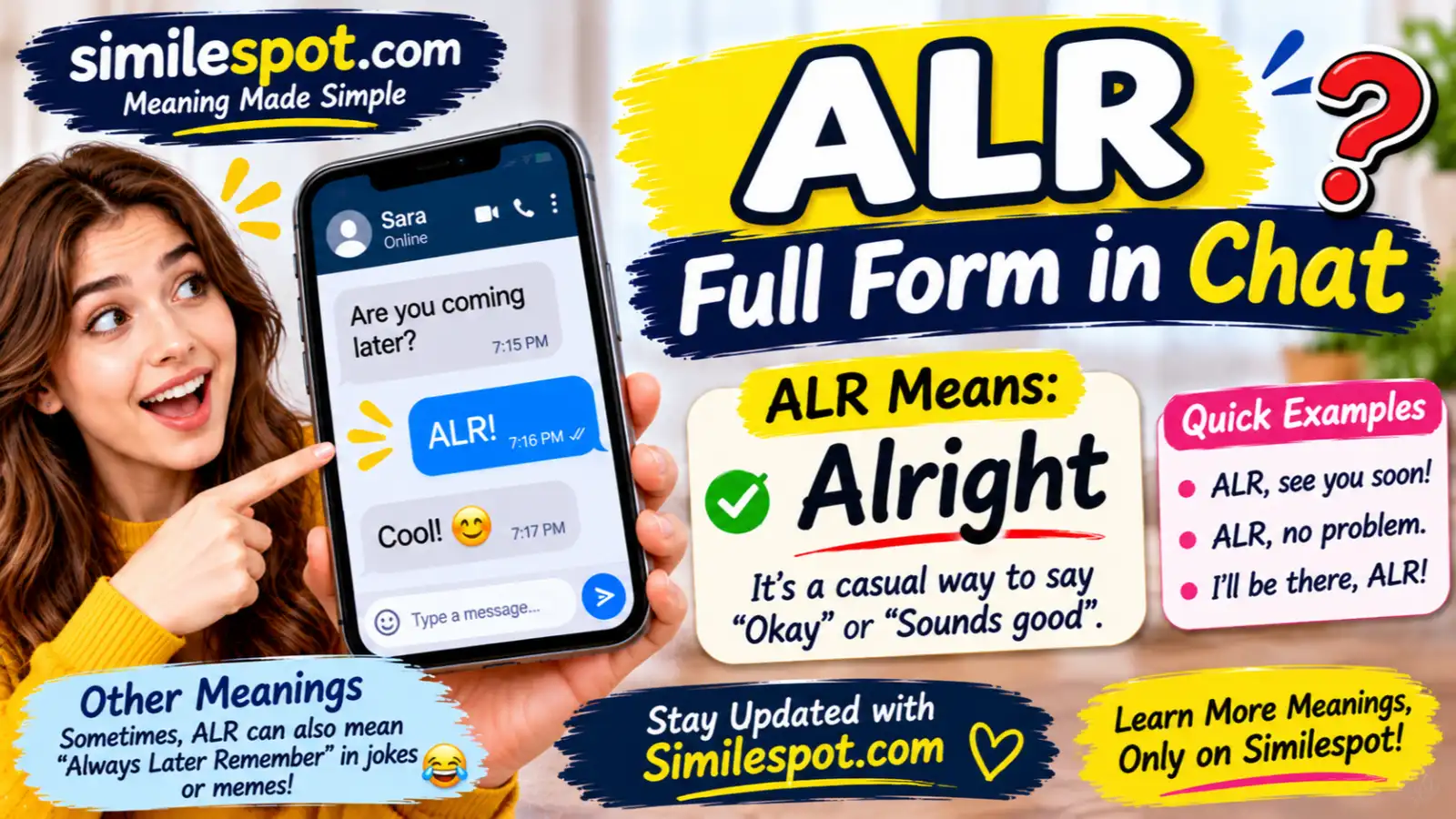
Have you ever received a message containing ALR and wondered what the sender was trying to say? Maybe a friend replied with just three letters, or you noticed the abbreviation in a social media comment. Short internet expressions can make conversations confusing, especially when you are unfamiliar with modern texting slang.
So, what is the ALR full form in chat?
ALR commonly stands for “Alright” in texting and online conversations. People use it as a shorter, casual way to say okay, fine, or understood. It can express agreement, acknowledgment, or acceptance, depending on the situation.
For example, if someone texts, “I’ll meet you at 6,” you might reply, “ALR.” This simply means that you understand and agree with the plan.
The abbreviation is popular because it is quick to type and easy to recognize in informal conversations. You may encounter it in text messages, Snapchat chats, Instagram comments, TikTok discussions, gaming conversations, and other online spaces.
However, the exact tone can change with context. Sometimes ALR sounds friendly and relaxed. In other situations, it may seem brief or slightly dismissive.
In this guide, you will learn the ALR full form in chat, its meaning, possible origins, everyday uses, examples, and differences from similar abbreviations. Let’s explore this simple but useful texting expression! 💬
1. What Is the ALR Full Form in Chat?
The most common ALR full form in chat is “Alright.”
It is an informal abbreviation that people use when they want to acknowledge a message, agree with something, or confirm that they understand.
Instead of typing the complete word “alright,” someone may write “ALR” to save time.
For example:
Person A: “I’ll send you the notes tonight.”
Person B: “ALR!”
Here, Person B is saying, “Alright!” or “Okay!”
Simple Definition of ALR
ALR = Alright
Depending on the conversation, it can communicate:
- Okay.
- Fine.
- Understood.
- Sounds good.
- I agree.
- No problem.
- That’s acceptable.
The abbreviation is especially common in casual digital communication. It is not usually suitable for formal writing, academic assignments, or professional documents.
Why Do People Use ALR?
People choose short abbreviations for several reasons:
- Faster communication: Typing three letters can be quicker than writing a complete word.
- Casual expression: It gives conversations a relaxed, informal tone.
- Convenience: It works well in quick replies.
- Texting habits: Many people naturally shorten common words when messaging friends.
- Online culture: Abbreviations are a familiar part of social media communication.
For example, imagine that your friend asks whether you are available to play a game later.
You could respond:
“ALR, I’m free!”
This means you agree and are ready to participate.
The main point is simple: ALR usually means alright, but its tone depends on the surrounding conversation.
2. What Does ALR Mean in Texting?
In texting, ALR is a quick way to acknowledge information or respond positively to a suggestion.
It often replaces longer replies such as “Okay, I understand” or “That sounds fine.”
People use it when they want to keep conversations moving without writing a complete sentence.
Common Uses of ALR in Text Messages
1. Showing Agreement
When someone suggests a plan, ALR can indicate that you agree.
Example:
Friend: “Let’s meet after school.”
You: “ALR!”
Meaning: You agree with the plan.
2. Confirming Information
You can use ALR to show that you have received and understood a message.
Example:
Friend: “Don’t forget to bring your notebook.”
You: “ALR, I won’t.”
Meaning: You understand the reminder.
3. Accepting a Request
ALR can also communicate that you are willing to do something.
Example:
Person A: “Can you help me with this assignment?”
Person B: “ALR, send it over.”
Meaning: Person B agrees to help.
4. Ending a Conversation
Sometimes people use ALR when they are ready to finish a discussion.
Example:
Person A: “I’ll talk to you tomorrow.”
Person B: “ALR, good night!”
Meaning: Person B acknowledges the message and ends the conversation politely.
Does ALR Always Sound Friendly?
Not necessarily.
A short reply can sometimes sound neutral, uninterested, or slightly impatient. However, you should not assume that someone is upset just because they send ALR.
Compare these examples:
| Message | Possible Tone |
|---|---|
| “ALR! See you soon 😊” | Friendly |
| “ALR, sounds good.” | Positive and relaxed |
| “alr” | Neutral or casual |
| “ALR then.” | Depends on the conversation |
| “alr…” | May suggest hesitation or uncertainty |
Punctuation, emojis, and previous messages can change how a reply feels.
3. Different Meanings of ALR Depending on Context
Although ALR most commonly means “alright” in chat, abbreviations can have different meanings in specialized subjects.
The context in which you see ALR is important.
For example, a person using ALR in a casual conversation is probably using texting slang. However, someone using the same letters in a technical document may mean something entirely different.
ALR in Everyday Conversations
In ordinary messaging, ALR generally means:
- Alright.
- Okay.
- Fine.
- Understood.
Example:
“ALR, I’ll call you later.”
ALR in Gaming Conversations
Gamers often use short expressions to communicate quickly.
ALR may be used to acknowledge a teammate’s suggestion or confirm a plan.
Example:
Player A: “Let’s move to the next level.”
Player B: “ALR, I’m ready.”
The player is agreeing with the suggestion.
ALR in Technical or Professional Contexts
In specialized fields, ALR can have other meanings depending on the industry and subject.
For example, it may appear as an abbreviation in technical documents, organizational terminology, or subject-specific writing.
These meanings should not automatically be applied to casual texting.
How to Identify the Correct Meaning
Use these three simple steps:
- Check the conversation: Look at the message before and after ALR.
- Consider the subject: Decide whether the conversation is casual, professional, or technical.
- Understand the tone: Look at punctuation, emojis, and the sender’s usual communication style.
If someone writes, “ALR, see you tomorrow,” the intended meaning is almost certainly “Alright.”
If you encounter ALR in a technical document, check the subject before interpreting it.
4. What Does ALR Mean on Snapchat, Instagram, and TikTok?
Social media platforms encourage short and quick communication. People often use abbreviations in direct messages, captions, comments, and replies.
ALR is one of the informal expressions you may encounter in these spaces.
Its usual texting meaning remains “Alright.” However, how people use it may vary depending on the conversation.
ALR Meaning on Snapchat 👻
Snapchat conversations are often casual and brief. Friends may use ALR when confirming plans or responding to a message.
Examples:
- “ALR, send me the picture.”
- “Alr, see you later.”
- “ALR, I’m coming.”
- “Alr, no problem.”
In these examples, ALR communicates acknowledgment or agreement.
ALR Meaning on Instagram 📸
Instagram users may use ALR in direct messages and comment sections.
Examples:
- “ALR, thanks for sharing.”
- “Alr, I’ll check it out.”
- “ALR, sounds interesting.”
- “Alr, let’s do it.”
It usually makes the response sound informal and conversational.
ALR Meaning on TikTok 🎵
TikTok users may use ALR in comments or replies when reacting to videos and discussions.
Examples:
- “ALR, that’s actually funny.”
- “Alr, I understand now.”
- “ALR, you got a point.”
- “Alr, fair enough.”
The abbreviation is not limited to one platform. Its meaning comes from the way people use it in everyday online communication.
ALR in Gaming Chats 🎮
Gaming conversations often move quickly, so short replies are useful.
For example:
Player A: “Are you joining our team?”
Player B: “ALR, invite me.”
Here, ALR means that the player agrees or is ready.
Remember: Snapchat, Instagram, and TikTok do not give ALR one exclusive meaning. In ordinary slang conversations, it commonly stands for “alright.”
5. Real-Life Examples of ALR in Conversations
The easiest way to understand texting slang is to see it in realistic situations.
Below are different conversations showing how people may use ALR.
Example 1: Making Plans
Friend A: “Let’s go shopping this weekend.”
Friend B: “ALR, sounds fun!”
Meaning: Friend B agrees with the suggestion.
Example 2: Confirming a Meeting
Person A: “I’ll meet you outside the library at 4.”
Person B: “Alr, see you there.”
Meaning: Person B understands and accepts the meeting arrangement.
Example 3: Accepting a Request
Friend A: “Can you send me the homework?”
Friend B: “ALR, I’ll send it soon.”
Meaning: Friend B agrees to share the homework.
Example 4: Responding to a Reminder
Person A: “Remember to bring your charger.”
Person B: “Alr, thanks for reminding me.”
Meaning: Person B acknowledges the reminder.
Example 5: Ending a Conversation
Friend A: “I have to go now. Talk tomorrow.”
Friend B: “ALR, take care!”
Meaning: Friend B understands and responds politely.
Example 6: Gaming With Friends
Player A: “Let’s start another round.”
Player B: “ALR, I’m ready.”
Meaning: Player B agrees to start another game.
Example 7: Responding to Good News
Friend A: “I got tickets for the concert!”
Friend B: “ALR, that’s awesome!”
Meaning: The response acknowledges the news, although a more enthusiastic reply might communicate excitement more clearly.
Example 8: Changing Plans
Person A: “Can we move our meeting to Friday?”
Person B: “Alr, Friday works for me.”
Meaning: Person B accepts the new arrangement.
Example 9: A Quick Reply
Friend A: “I’ll message you when I arrive.”
Friend B: “ALR.”
Meaning: Friend B understands and acknowledges the message.
Example 10: Accepting an Invitation
Person A: “You’re invited to my birthday party!”
Person B: “ALR, I’ll be there!”
Meaning: Person B accepts the invitation.
Example 11: Asking for Help
Person A: “Could you explain this question to me?”
Person B: “ALR, send it here.”
Meaning: Person B agrees to help.
Example 12: Responding to an Update
Friend A: “The class has been moved to Monday.”
Friend B: “Alr, thanks for letting me know.”
Meaning: Friend B has understood the updated schedule.
These examples show that ALR is a flexible expression. It can confirm plans, acknowledge information, and show agreement without requiring a long response.
6. How to Reply When Someone Sends ALR
If someone sends you ALR, your response depends on what they are acknowledging.
In many cases, you do not need to reply with another abbreviation. A natural response is enough.
When ALR Means Agreement
If someone agrees with your plan, you can say:
- “Great!”
- “Sounds good.”
- “See you there!”
- “Perfect!”
- “Looking forward to it!”
Example:
You: “Let’s meet at 5 p.m.”
Friend: “ALR.”
You: “Great, see you then!”
When ALR Confirms Information
If someone acknowledges your message, you can simply continue the conversation.
Possible replies:
- “Thanks!”
- “Appreciate it.”
- “Perfect.”
- “That’s all.”
- “Let me know if you need anything.”
When ALR Seems Uninterested
Sometimes a short reply may feel less enthusiastic than expected.
However, ALR alone does not prove that someone is annoyed.
If you need clarification, you can ask:
- “Everything okay?”
- “Does that work for you?”
- “Are you sure?”
- “Let me know if you have any concerns.”
Avoid assuming someone’s emotions based on three letters.
Quick Reply Table
| Their Message | Possible Reply |
|---|---|
| “ALR, see you tomorrow.” | “See you!” |
| “Alr, I’ll do it.” | “Thank you!” |
| “ALR, sounds good.” | “Perfect!” |
| “Alr, no problem.” | “Appreciate it.” |
| “ALR, I’m ready.” | “Let’s go!” |
| “Alr, talk later.” | “Take care!” |
The best response is usually short, friendly, and relevant to the conversation.
7. Origin and Evolution of ALR in Internet Slang
The abbreviation ALR developed from a broader habit of shortening everyday words in digital communication.
People have always looked for convenient ways to communicate. As text messaging and online chats became popular, shorter spellings became a familiar part of informal writing.
Why Did People Start Shortening Words?
There are several reasons behind the popularity of internet abbreviations.
1. Faster Typing
Shorter words can make quick conversations easier.
Instead of typing “alright,” someone can simply write “ALR.”
2. Limited Message Space
Early mobile messaging encouraged people to keep messages short because some systems limited the number of characters in a message.
3. Informal Communication
Friends often prefer relaxed language when messaging each other.
Short forms can make conversations feel less formal.
4. Social Media Habits
Online platforms made short comments and quick replies part of everyday communication.
5. Repeated Use
When users see an abbreviation regularly, they may begin using it naturally in their own messages.
How Did ALR Become Familiar?
ALR follows a common informal spelling pattern: removing letters from a familiar word while keeping enough of its original form for readers to recognize it.
Similar shortened forms appear throughout internet slang.
For example:
- “Srsly” for “seriously.”
- “Thx” for “thanks.”
- “Pls” for “please.”
- “Rly” for “really.”
ALR fits this general style of abbreviated writing.
Is There One Confirmed Creator of ALR?
There is no single widely established creator or exact starting date for the modern texting use of ALR.
It is more accurate to understand it as a shortened form that developed through informal digital communication.
Today, people recognize it in many casual online conversations.
8. ALR vs. Similar Texting Abbreviations
ALR is part of a large collection of internet abbreviations. Some expressions have similar meanings, while others communicate different feelings or responses.
Understanding these differences helps you choose the right expression.
Common Abbreviations Similar to ALR
| Abbreviation | Full Form | Meaning |
|---|---|---|
| ALR | Alright | Okay or understood |
| OK | Okay | Agreement or acknowledgment |
| K | Okay | Very short acknowledgment |
| BET | Bet | Agreement or confirmation |
| AIGHT | Alright | Informal version of alright |
| YEP | Yes | Informal agreement |
| SURE | Sure | Agreement or willingness |
| IDC | I Don’t Care | Lack of concern |
| NVM | Never Mind | Forget what was said |
| BRB | Be Right Back | Temporary absence |
| IMO | In My Opinion | Introducing an opinion |
| FR | For Real | Agreement or emphasis |
ALR vs. OK
Both expressions can communicate agreement.
- ALR: An informal shortened version of alright.
- OK: A widely recognized word used to show agreement or acknowledgment.
Example:
“ALR, I’ll call you later.”
“OK, I’ll call you later.”
Both sentences communicate a similar idea.
ALR vs. K
K is an extremely short way of saying okay.
However, it can sometimes sound abrupt depending on the relationship and conversation.
ALR may feel slightly more conversational, although tone depends on the sender.
ALR vs. BET
BET is often used to express agreement, confidence, or acceptance of a suggestion.
Example:
Friend: “Let’s meet at 7.”
Reply: “BET!”
This can mean that the person agrees with the plan.
ALR can communicate a similar response, but the expressions have different slang styles.
ALR vs. AIGHT
AIGHT is an informal spelling of “alright.”
It is close in meaning to ALR and may appear in casual conversations.
Example:
“Aight, see you later.”
“ALR, see you later.”
Both can communicate acknowledgment or agreement.
Which One Should You Use?
Choose an abbreviation that fits your conversation and audience.
- Use ALR for a casual acknowledgment.
- Use OK when you want a widely understood response.
- Use BET for informal agreement.
- Use AIGHT for a relaxed conversational style.
- Use SURE when accepting a request politely.
You do not need to use slang in every message. Clear communication matters more than using the shortest possible expression.
9. Is ALR Formal or Informal?
ALR is an informal texting abbreviation. It is generally appropriate for casual conversations but not recommended for formal or professional writing.
It works well when messaging friends, relatives, classmates, and people who understand internet slang.
However, complete words are usually better in professional communication.
Where Can You Use ALR?
You can use ALR in situations such as:
- Texting friends.
- Chatting with family members.
- Sending quick social media replies.
- Talking in gaming groups.
- Responding to casual invitations.
- Confirming everyday plans.
- Having informal online conversations.
Where Should You Avoid ALR?
Avoid using ALR in:
- Formal emails.
- School assignments.
- Business proposals.
- Job applications.
- Official announcements.
- Academic reports.
- Professional presentations.
Informal vs. Formal Examples
| Informal Version | Formal Version |
|---|---|
| “ALR, I’ll be there.” | “Alright, I will be there.” |
| “Alr, thanks!” | “Thank you for the information.” |
| “ALR, sounds good.” | “That arrangement works for me.” |
| “Alr, I’ll check.” | “I will review it.” |
| “ALR, no problem.” | “Certainly, that will not be a problem.” |
Why Does Formality Matter?
Different situations require different communication styles.
Your friends may understand ALR immediately. However, a teacher, employer, or customer may expect complete words and more professional language.
Using the right level of formality makes your communication easier to understand and more appropriate for the situation.
10. Common Mistakes People Make When Using ALR
Although ALR is easy to understand, people can sometimes misunderstand its tone or use it in the wrong situation.
Here are common mistakes worth avoiding.
Mistake 1: Thinking ALR Has Only One Possible Meaning Everywhere
In ordinary texting, ALR commonly means alright. However, abbreviations can have specialized meanings in other fields.
Always consider the subject and surrounding words.
Mistake 2: Assuming ALR Means Someone Is Angry
A short reply does not automatically indicate frustration.
Someone may simply be busy, typing quickly, or using their usual texting style.
For example:
Friend: “I’ll send you the details later.”
You: “ALR.”
This is a normal acknowledgment, not necessarily a sign of irritation.
Mistake 3: Using ALR in Every Conversation
Not everyone understands internet slang.
If you are messaging someone unfamiliar with abbreviations, writing “Alright” may be clearer.
Mistake 4: Confusing ALR With Other Short Forms
ALR, AIGHT, OK, and BET can all express agreement, but they are not identical in style or use.
Learn the differences before using them.
Mistake 5: Using ALR in Formal Documents
A casual abbreviation may make professional writing appear careless.
Use complete words in official communication.
Mistake 6: Ignoring Punctuation and Emojis
The same abbreviation can communicate different tones depending on how it appears.
Compare:
- “ALR 😊” — may sound friendly.
- “ALR!” — may sound enthusiastic or decisive.
- “alr.” — may feel neutral or abrupt.
- “ALR, thanks!” — sounds appreciative.
These are possible impressions, not fixed rules. The sender’s usual communication style also matters.
Mistake 7: Overthinking a Simple Reply
Sometimes ALR means exactly what it says: alright.
You do not need to search for a hidden meaning every time someone uses it.
If the message is unclear, simply ask for clarification.
FAQs:
1. What is the ALR full form in chat?
The most common ALR full form in chat is “Alright.” It is an informal abbreviation used to express agreement, acknowledgment, or understanding in text messages and online conversations.
2. Does ALR mean alright or already?
In common texting slang, ALR usually means “alright.” It should not automatically be interpreted as “already.” The surrounding sentence can help you understand the intended meaning.
3. What does ALR mean on Snapchat?
On Snapchat, ALR generally means “alright.” People use it in direct messages to confirm plans, acknowledge information, or agree with something a friend says.
4. Is ALR rude in texting?
No, ALR is not automatically rude. It is usually a casual acknowledgment. However, a very short reply may sometimes seem abrupt depending on the conversation, punctuation, and relationship between the people messaging.
5. What is the difference between ALR and OK?
Both ALR and OK can express agreement or acknowledgment. ALR is a shortened form of “alright,” while OK is a widely recognized expression used in both casual and more formal situations.
Conclusion:
Now you know that the most common ALR full form in chat is “Alright.”
People use this abbreviation to agree with a suggestion, confirm information, accept a request, or acknowledge a message. It is especially common in informal texting and social media conversations.
Here are the key points to remember:
- ALR stands for Alright in common texting slang.
- It can mean okay, understood, or sounds good.
- People use it in text messages, Snapchat, Instagram, TikTok, and gaming chats.
- Its tone depends on the conversation and the sender’s writing style.
- It is informal, so complete words are better for professional communication.
- Similar expressions include OK, BET, AIGHT, and SURE.
The next time someone sends you ALR, you will understand what they most likely mean. You can respond naturally without getting confused by this popular short form.
Want to understand more internet slang? Explore related texting abbreviations, social media expressions, and everyday word meanings to make your online conversations easier and more confident. 💬

I am a passionate writer at SimileSpot who loves playing with words. I create clear and creative similes to make ideas easy to understand and fun to read.